Frederick Nicholls Crouch (July 30, 1808 – August 18, 1896) was an English composer and cellist.
Crouch was born in Marylebone in London. He emigrated to the United States in 1849 and settled in Richmond, Virginia. During the Civil War, Crouch took up arms and played the trumpet for the Confederacy.
Crouch was noted as a fine cellist, having played in the King's Theatre as well as St Paul's Cathedral in London, before coming to the United States, but the majority of his compositions were not successful. His most famous song is 'Kathleen Mavourneen'.
During his years in the United States, Crouch composed two operas and unsuccessfully tried various musical undertakings (i.e., conducting, singing and teaching). Well traveled after the Civil War, Crouch eventually settled in Baltimore, Maryland.
Emma Elizabeth Crouch (1835–1886), the second daughter of his first marriage, became known in Second Empire France as the courtesan Cora Pearl. (Rétracter)...(Lire la suite)
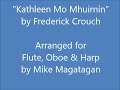
Kathleen Mo Mhuirnín ("Kathleen Mavourneen" or My Beloved Kathleen) is a song, written in 1837, composed by Frederick Crouch with lyrics by Marion Cr...
Kathleen Mo Mhuirnín ("Kathleen Mavourneen" or My Beloved Kathleen) is a song, written in 1837, composed by Frederick Crouch with lyrics by Marion Crawford. It was popular during the American Civil War. "Mavourneen" is a term of endearment derived from the Irish Gaelic mo mhuirnín, meaning "my beloved."
The Irish soprano Catherine Hayes (1818–1861), the Hibernian prima donna, was the first Irish woman to sing at La Scala in Milan. She learned Kathleen Mavourneen while training in Dublin. It became her signature tune during concerts and in fact, Catherine Hayes sang it for Queen Victoria and over 500 royal guests during a concert performed at Buckingham Palace in June 1849.
During several very successful years in Italy, Catherine Hayes became the foremost Lucia di Lammermoor in the 1840s. She toured around the world between 1851 and 1856. She circumnagivated the globe, performing in operas and singing concerts. The trip began in New York in 1851 and over the next few years, she appeared in over 40 other cities on the east coast of the USA and Canada. From there she toured extensively across the US - Charleston SC, Savannah GA, New Orleans and Baton Rouge LA, Memphis and Nashville TN, San Francisco and Sacramento CA, (1851–53) Lima (Peru), Valparaiso and Santiago (Chili)(1853–54), Honolulu Hawaii (July 1854), Sydney, Melbourne, Geelong and Adelaide (Australia)(1854 and again in 1855), Bendigo, Hobart (Tasmania 1856), Calcutta, Singapore, Java (1855).
The song Kathleen Mavourneen gained popularity with American audiences as a direct result of the extensive touring of Catherine Hayes.
The song plays a prominent role in Michael Shaara's Civil War historical novel The Killer Angels and its film adaptation Gettysburg. It is recalled by Confederate Brigadier General Lewis A. Armistead that the song was sung at a dinner at the home of Armistead's best friend, now Union Major General Winfield Scott Hancock and his wife Almira, at the U.S. Army garrison in Los Angeles, California in 1861 (at which time Armistead was a major and Hancock was a captain). This was the night before Armistead and several other Southern officers were to depart for the Confederacy, having resigned their US Army commissions. Armistead and Confederate Brigadier General Richard B. Garnett, who was also present at the dinner, are killed and Hancock is severely wounded as Armistead's and Garnett's brigades assault the position defended by Hancock's II Corps on Cemetery Ridge in Gettysburg during Pickett's Charge. In the film, "Kathleen Mavourneen" is sung once by an Irish tenor at the Confederate camp, and thereafter is used frequently as a theme in the music score by Randy Edelman.
Although this work was originally written for Folk Instruments, I created this arrangement for Flute, Oboe & Concert (Pedal) Harp.



 STUDIO
 SONO
SONO ACCESSOIRES
 CABLES
 EFFET
EFFET FLIGHTCASE & ETUIS
 LOGICIELS
 VIDEO
VIDEO LUMIERE
 DEEJAY
 MICROPHONE
 GUITARE
 CLAVIER
 PERCUSSION
 CUIVRE / VENT
 CORDES/TRAD.
 NOËL
NOËL