Johann Sebastian Bach (21 mars 1685 - 28 juillet 1750), en français Jean-Sébastien Bach, est un compositeur, claveciniste, violoniste et organiste allemand.
Compositeur de l'époque baroque dont il symbolise et personnifie l'apogée, il eut une influence majeure et durable dans le développement de la musique occidentale ; de grands compositeurs, tels que Mozart et Beethoven, reconnurent en lui un maître du contrepoint insurpassable.
Il fut un musicien complet qui maîtrisait la facture des instruments tout autant que la technique instrumentale, la composition comme l'improvisation, la pédagogie comme la gestion d'une institution musicale.
Localement connu de son vivant comme organiste et improvisateur, sa musique fut toutefois vite oubliée après son décès, car passée de mode ; son ?uvre, à de rares exceptions près, manuscrite et jamais publiée, dispersée et en partie perdue, fut redécouverte et étudiée par les romantiques. (Rétracter)...(Lire la suite)
The "Concerto I" in A minor, BWV 1041, was composed by Johann Sebastian Bach as a Violin Concerto. It is unknown exactly when the work was composed, b...
The "Concerto I" in A minor, BWV 1041, was composed by Johann Sebastian Bach as a Violin Concerto. It is unknown exactly when the work was composed, but copies dated 1730 suggest it may have been composed later than the other two concertos for violin, perhaps during Bach's time as director of the Collegium Musicum in Leipzig.
The piece has three movements:
1. Allegro moderato
2. Andante — with an ostinato style theme
3. Allegro assai
The motifs of the theme of the Allegro moderato appear in changing combinations and are separated and intensified throughout the movement.
In the Andante Bach uses an insistent pattern in the bass part that is repeated constantly in the movement. He focuses the variation in the harmonic relations.
In the final movement Bach relies on bariolage figures to generate striking acoustic effects.
The piece is a baroque concerto which is in ritornello form. This means that there is a main section that comes back in fragments in both the solo and orchestral parts. This 'ritornello' can be found in the first movement up until bar 24.
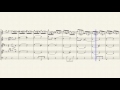
Although this piece was originally written for String Orchestra, I arranged it for Woodwind Quintet (Flute, Oboe, Clarinet, French Horn & Bassoon).



 STUDIO
 SONO
SONO ACCESSOIRES
 CABLES
 EFFET
EFFET FLIGHTCASE & ETUIS
 LOGICIELS
 VIDEO
VIDEO LUMIERE
 DEEJAY
 MICROPHONE
 GUITARE
 CLAVIER
 PERCUSSION
 CUIVRE / VENT
 CORDES/TRAD.
 NOËL
NOËL