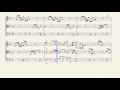
Johann Friedrich Fasch est un compositeur, violoniste et organiste allemand, né à Buttelstädt près de Weimar le 15 avril 1688 et décédé à Zerbst le 5 décembre 1758
Johann Friedrich Fasch aborda la musique comme choriste avant d?être enrôlé par Johann Kuhnau à la célèbre Thomasschule de Leipzig ; il étudia ensuite à l?Université de Leipzig de 1708 à 1711. Sans avoir reçu de formation de compositeur, il commença à composer et sa réputation se fit si rapidement que son souverain lui commanda des opéras en 1711 et 1712. C?est vers ces années que Fasch entreprit d?étudier la composition à Darmstadt avec Johann Christoph Graupner et Gottfried Grünewald. Il occupa par ailleurs quelques postes, notamment de violoniste à Bayreuth, d?organiste à Greiz, et de maître de chapelle à la cour du comte Morzin à Lukavec. En 1722, il accepta le poste de maître de chapelle à Zerbst où il resta jusqu?à la fin de ses jours.
Johann Friedrich Fasch composa dans presque tous les genres musicaux en vogue à son époque. Il fut un compositeur respecté de tous, y compris de Jean-Sébastien Bach qui transcrivit plusieurs ouvertures de Fasch.
L?élément le plus important est sans aucun doute la transition que l??uvre de Fasch réalise entre les styles baroque et classique : d?après Gottfried Küntzel, Fasch « développa le vocabulaire d?un nouveau langage musical sur une trame formelle traditionnelle; dans certaines de ses ?uvres tardives, il anticipa de manière tout à fait remarquable les idiomes ? mais pas les structures formelles ? utilisées ensuite par Gluck, Haydn et Mozart. » (Rétracter)...(Lire la suite)
Johann Friedrich Fasch (1688 – 1758) was a German violinist and composer born in the town of Buttelstedt, 11 km north of Weimar, the eldest child of...
Johann Friedrich Fasch (1688 – 1758) was a German violinist and composer born in the town of Buttelstedt, 11 km north of Weimar, the eldest child of schoolmaster Friedrich Georg Fasch and his wife Sophie Wegerig, from Leißling near Weißenfels. After his father's death in 1700, Fasch lived with his mother's brother, the clergyman Gottfried Wegerig in Göthewitz, and it was presumably in this way that he came made the acquaintance of the Opera composer Reinhard Keiser.
Fasch was a choirboy in Weissenfels and studied under Johann Kuhnau at the St. Thomas School in Leipzig. It was in Leipzig in 1708 that he founded a Collegium Musicum. in 1711 he wrote an opera to be performed at the Peter-Paul Festival in Naumburg, and a second one for the festival in 1712.
In 1714, unable to procure aristocratic patronage for a journey to Italy, Fasch instead travelled to Darmstadt to study composition for three months under his former Leipzig prefect Christoph Graupner and Gottfried Grünewald. He then traveled extensively in Germany, becoming a violinist in the orchestra in Bayreuth in 1714, was an amanuensis in Gera till 1719 and from 1719 until 1721 held a court post as organist in Greiz.
His next major post was Prague, where he served for two years as Kapellmeister and court composer to Count Morzin,. In 1722, he "reluctantly accepted the position" of court Kapellmeister at Zerbst, a post he held until his death. (The organist Johann Ulich was his assistant.) Also in 1722, he was invited to apply for the position of Thomaskantor in Leipzig at his alma mater, the St. Thomas School, but he chose to withdraw his name from the competition. The Leipzig opening was eventually filled by Johann Sebastian Bach, who had considerable esteem for Fasch.
Although formerly attributed to J. S. Bach, this work has been determined to have been composed by Johann Friedrich Fasch, a Bach contemporary. In fact, it is often called the Fasch Trio in concert performances and on recordings, even though it is still listed in many catalogs of Bach's compositions. The work likely dates to the early 1700s, when both composers were still finding their stylistic ways. It consists of two movements, an Adagio of three-and-a-half minutes' duration or so, and an Allegro, two-thirds that length. The first movement opens gently and dreamily in the upper ranges, the theme serene and contented. It exhibits quite the kind of melodic material and mood heard in many Bach organ works, but the contrapuntal writing lacks the imagination generally associated with that master's finer keyboard works. The Allegro opens at a lively but hardly breakneck pace, its mood brighter but still divulging that sense of ethereality from the opening panel. Again, contrapuntal features, while well-crafted enough, are not particularly inspired. Still, this gentle piece will have appeal for both Bach and Baroque-era enthusiasts.



 STUDIO
 SONO
SONO ACCESSOIRES
 CABLES
 EFFET
EFFET FLIGHTCASE & ETUIS
 LOGICIELS
 VIDEO
VIDEO LUMIERE
 DEEJAY
 MICROPHONE
 GUITARE
 CLAVIER
 PERCUSSION
 CUIVRE / VENT
 CORDES/TRAD.
 NOËL
NOËL