Johann Sebastian Bach (21 mars 1685 - 28 juillet 1750), en français Jean-Sébastien Bach, est un compositeur, claveciniste, violoniste et organiste allemand.
Compositeur de l'époque baroque dont il symbolise et personnifie l'apogée, il eut une influence majeure et durable dans le développement de la musique occidentale ; de grands compositeurs, tels que Mozart et Beethoven, reconnurent en lui un maître du contrepoint insurpassable.
Il fut un musicien complet qui maîtrisait la facture des instruments tout autant que la technique instrumentale, la composition comme l'improvisation, la pédagogie comme la gestion d'une institution musicale.
Localement connu de son vivant comme organiste et improvisateur, sa musique fut toutefois vite oubliée après son décès, car passée de mode ; son ?uvre, à de rares exceptions près, manuscrite et jamais publiée, dispersée et en partie perdue, fut redécouverte et étudiée par les romantiques. (Rétracter)...(Lire la suite)
The Partita in D minor for solo violin (BWV 1004) by Johann Sebastian Bach was written during 1717--1723. Professor Helga Thoene suggests that this pa...
The Partita in D minor for solo violin (BWV 1004) by Johann Sebastian Bach was written during 1717--1723. Professor Helga Thoene suggests that this partita, and especially its last movement, was a tombeau written in memory of Bach's first wife, Maria Barbara Bach (who died in 1720), though this theory is controversial.
In the preface to his 1955 transcription, John Cook writes: "The Chaconne is sublimely satisfying in its original form, yet many will agree that a single violin is only able to hint at the vast implications of much of this music ... It is perhaps not unreasonable to suppose that Bach would have chosen the organ, had he transcribed the Chaconne himself, as the instrument best suited to the scale of his ideas ... A good performance on the violin may be taken as the best guide to interpretation on the organ — the two instruments are not without their points in common, and both were beloved of Bach."
The earliest version for organ is by William Thomas Best. Further transcriptions are by John Cook, Wilhelm Middelschulte, Walter Henry Goss-Custard (1915--55), and Henri Messerer (1838--1923).
Since Bach's time, several different transcriptions of the piece have been made for other instruments, particularly for the piano (by Ferruccio Busoni and Joachim Raff), and for the piano left-hand (by Brahms). Johannes Brahms, in a letter to Clara Schumann, said about the ciaccona: On one stave, for a small instrument, the man writes a whole world of the deepest thoughts and most powerful feelings. If I imagined that I could have created, even conceived the piece, I am quite certain that the excess of excitement and earth-shattering experience would have driven me out of my mind. Felix Mendelssohn and Robert Schumann each wrote piano accompaniments for the work.
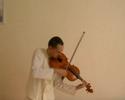
Although this piece was originally written for Violin, I transcribed it for Solo Viola.



 STUDIO
 SONO
SONO ACCESSOIRES
 CABLES
 EFFET
EFFET FLIGHTCASE & ETUIS
 LOGICIELS
 VIDEO
VIDEO LUMIERE
 DEEJAY
 MICROPHONE
 GUITARE
 CLAVIER
 PERCUSSION
 CUIVRE / VENT
 CORDES/TRAD.
 NOËL
NOËL