Johann Sebastian Bach (21 mars 1685 - 28 juillet 1750), en français Jean-Sébastien Bach, est un compositeur, claveciniste, violoniste et organiste allemand.
Compositeur de l'époque baroque dont il symbolise et personnifie l'apogée, il eut une influence majeure et durable dans le développement de la musique occidentale ; de grands compositeurs, tels que Mozart et Beethoven, reconnurent en lui un maître du contrepoint insurpassable.
Il fut un musicien complet qui maîtrisait la facture des instruments tout autant que la technique instrumentale, la composition comme l'improvisation, la pédagogie comme la gestion d'une institution musicale.
Localement connu de son vivant comme organiste et improvisateur, sa musique fut toutefois vite oubliée après son décès, car passée de mode ; son ?uvre, à de rares exceptions près, manuscrite et jamais publiée, dispersée et en partie perdue, fut redécouverte et étudiée par les romantiques. (Rétracter)...(Lire la suite)
It is generally accepted that Johann Sebastian Bach wrote his six Sonatas for Organ for his eldest son, Wilhelm Friedemann Bach, as the not always rel...
It is generally accepted that Johann Sebastian Bach wrote his six Sonatas for Organ for his eldest son, Wilhelm Friedemann Bach, as the not always reliable W.F. often asserted. There is no strong reason to disbelieve it, for they appeared at about the right time and, moreover, are teaching pieces par excellence. There is a world of difference between the familiar Bach organ works in the mold of the various preludes or toccatas and fugues and the Six Sonatas. Compared to those works, these Sonatas are light, transparent in texture, never concerned with display or Baroque flamboyance. They are Trio-Sonatas, works in three voices, irrespective of how many actual players were needed. The voices in these works are independent: one in either hand, the third on the pedals. Ordinarily, each hand plays on its own manual. Thus, the Sonatas test and cultivate the student's physical and mental ability to coordinate all these separate motions of hands and feet, the interpretive ability to project each voice equally and clearly to the audience, and the musical ability to make them meaningful.
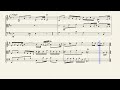
This (fourth) Sonata is written in the form of a concerto for organ. The first movement is a Vivace preceded by a short slow introduction. It is a transcription of a sinfonia of the cantata Die Himmel erzählen die Ehre Gottes, BWV 76 (1723). This number was already a trio for oboe d'amore, viola, and bass line. It is in a ritornello form, with a lively main episode interspersed with contrasting sections. The slow (second) movement seems to have originated as a separate piece. The concluding (Un Poco Allegro) section is vigorous and tests coordination by throwing in triplets that cross hands on Keyboard as well as on flute.
Although originally created for organ, I adapted this work for String Trio (Violin, Viola & Cello) .



 STUDIO
 SONO
SONO ACCESSOIRES
 CABLES
 EFFET
EFFET FLIGHTCASE & ETUIS
 LOGICIELS
 VIDEO
VIDEO LUMIERE
 DEEJAY
 MICROPHONE
 GUITARE
 CLAVIER
 PERCUSSION
 CUIVRE / VENT
 CORDES/TRAD.
 NOËL
NOËL