Johann Sebastian Bach (21 mars 1685 - 28 juillet 1750), en français Jean-Sébastien Bach, est un compositeur, claveciniste, violoniste et organiste allemand.
Compositeur de l'époque baroque dont il symbolise et personnifie l'apogée, il eut une influence majeure et durable dans le développement de la musique occidentale ; de grands compositeurs, tels que Mozart et Beethoven, reconnurent en lui un maître du contrepoint insurpassable.
Il fut un musicien complet qui maîtrisait la facture des instruments tout autant que la technique instrumentale, la composition comme l'improvisation, la pédagogie comme la gestion d'une institution musicale.
Localement connu de son vivant comme organiste et improvisateur, sa musique fut toutefois vite oubliée après son décès, car passée de mode ; son ?uvre, à de rares exceptions près, manuscrite et jamais publiée, dispersée et en partie perdue, fut redécouverte et étudiée par les romantiques. (Rétracter)...(Lire la suite)
Although authorship by J. S. Bach is doubtful according to most scholars, the fugal writing is quite similar to the one found in the 8 Little Preludes...
Although authorship by J. S. Bach is doubtful according to most scholars, the fugal writing is quite similar to the one found in the 8 Little Preludes and Fugues. If Bach did compose this Fugue, he likely wrote it during the earliest years of the eighteenth century when he was still a student. The work is not an inconsequential one in either scope or length, having a fairly substantial structure and lasting around five or six minutes. The fugal writing is interesting, though not as distinctive in its more calculating manner as is heard in most other Bach fugues. That said, the music is well-crafted and in the end worthwhile, if minor. The Fugue opens with a lively, stately theme presented in single notes that immediately turns fugal. In the wrong hands this work can sound tedious, since the theme repeats throughout and thus requires its contrapuntal features to be sharply detailed and brought into proper focus. Near the end there is a cadenza-like episode that builds up to a grand close, the theme triumphantly resounding. This Fugue has a glorious sense about it, not unlike the style of many of Bach's more ecstatic chorale preludes. Still, one cannot clearly identify the distinctive voice of the composer's mature or even early years here.
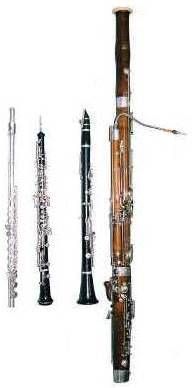
Although originally composed for Organ, I created this modern interpretation of the Fugue in G Major (BWV 576) for Double-Reed Quartet (2 Oboes, English Horn & Bassoon).



 STUDIO
 SONO
SONO ACCESSOIRES
 CABLES
 EFFET
EFFET FLIGHTCASE & ETUIS
 LOGICIELS
 VIDEO
VIDEO LUMIERE
 DEEJAY
 MICROPHONE
 GUITARE
 CLAVIER
 PERCUSSION
 CUIVRE / VENT
 CORDES/TRAD.
 NOËL
NOËL