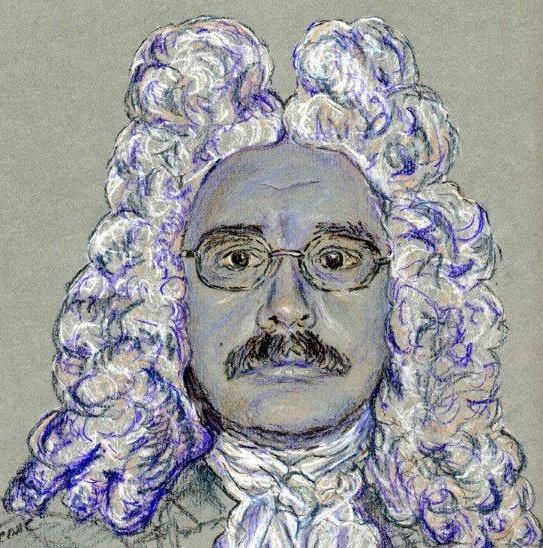
Johann Sebastian Bach (21 mars 1685 - 28 juillet 1750), en français Jean-Sébastien Bach, est un compositeur, claveciniste, violoniste et organiste allemand.
Compositeur de l'époque baroque dont il symbolise et personnifie l'apogée, il eut une influence majeure et durable dans le développement de la musique occidentale ; de grands compositeurs, tels que Mozart et Beethoven, reconnurent en lui un maître du contrepoint insurpassable.
Il fut un musicien complet qui maîtrisait la facture des instruments tout autant que la technique instrumentale, la composition comme l'improvisation, la pédagogie comme la gestion d'une institution musicale.
Localement connu de son vivant comme organiste et improvisateur, sa musique fut toutefois vite oubliée après son décès, car passée de mode ; son ?uvre, à de rares exceptions près, manuscrite et jamais publiée, dispersée et en partie perdue, fut redécouverte et étudiée par les romantiques. (Rétracter)...(Lire la suite)
The Orgelbüchlein ("Little Organ Book") BWV 599-644 is a collection of 46 chorale preludes for organ written by Johann Sebastian Bach. All but three ...
The Orgelbüchlein ("Little Organ Book") BWV 599-644 is a collection of 46 chorale preludes for organ written by Johann Sebastian Bach. All but three of them were composed during the period 1708–1717, while Bach was court organist at the ducal court in Weimar. The remaining three, along with a short two-bar fragment, were added in 1726 or later, after Bach's appointment as cantor at the Thomasschule in Leipzig.
The collection was originally planned as a set of 164 chorale preludes spanning the whole liturgical year. The chorale preludes form the first of Bach's masterpieces for organ with a mature compositional style in marked contrast to his previous compositions for the instrument. Although each of them takes a known Lutheran chorale and adds a motivic accompaniment, Bach explored a wide diversity of forms in the Orgelbüchlein. Many of the chorale preludes are short and in four parts, requiring only a single keyboard and pedal, with an unadorned cantus firmus. Others involve two keyboards and pedal: these include several canons, four ornamental four-part preludes, with elaborately decorated chorale lines, and a single chorale prelude in trio sonata form. The Orgelbüchlein has a four-fold purpose: it is a collection of organ music for church services, a treatise on composition, a religious statement, and an organ-playing manual.
Though this is a tiny piece of organ music, its expressive power is undiminished. In this chorale arrangement, Bach aptly illustrated the text from the 1713 Geistreiches Gesangbuch from Weimar: ‘I have suffered and fought, but now my life is at an end and I can die in peace’. These are the words of the aged Simeon, who has seen his Saviour, as God had promised him. The legato yet persistent melody is played on the upper keyboard, while the left hand represents the restless feet anxious to enter the next world. Meanwhile, the pedal knocks steadily at the gates of heaven, in the firm conviction that the reward for earthly labours is close at hand.
Source: Wikipedia (https://en.wikipedia.org/wiki/Orgelb%C3%BCchlein).
Although originally created for Organ, I created this Interpretation of Choral Prelude (BWV 617) "Herr Gott, nun schleuß den Himmel auf" (Lord God, now unlock Heaven) for Classical Guitar Duet.



 STUDIO
 SONO
SONO ACCESSOIRES
 CABLES
 EFFET
EFFET FLIGHTCASE & ETUIS
 LOGICIELS
 VIDEO
VIDEO LUMIERE
 DEEJAY
 MICROPHONE
 GUITARE
 CLAVIER
 PERCUSSION
 CUIVRE / VENT
 CORDES/TRAD.
 NOËL
NOËL