
The clarinet method op. 63 by Carl Baermann from 1867 is still a standard work i...(+)
The clarinet method op. 63 by Carl Baermann from 1867 is still a standard work in classical clarinet education today. The thoroughly revised new edition aims at reviewing the educational concept, which is still valid today, for modern lessons, adjusting the music and texts, and sensibly complementing the teaching contents.The editor who draws on many years of experience as a clarinettist in an orchestra and university lecturer of clarinet has succeeded in adapting the valuable teaching material to the requirements of today while maintaining the basic methodology. The result is a total of 7 volumes:Clarinet Method Vol. 1 and Vol. 2 (ED 21761, ED 21762)Clarinet Method Vol. 1 and Vol. 2, with 2 CDs each (ED 21761-50, ED 21762-50): The CDs contain the piano accompaniment for the performance pieces, with and without clarinetTune Book 1 and 2 (ED 21763, ED 21764): piano score of the method's performance pieces, with additional inserted clarinet partDaily Exercises (ED 21765): systematic scale, interval and chord exercises in all keys, complemented and published separately from the original methodDue to trilingual nature of all editions (German, English, French), they can be used universally.About the revision:The musical text is based on the first edition of the method. Only a few differences concerning the articulation as well as some misprints and typographical errors were revised. By deleting the historical fingering instructions for the German fingering system, the clarinet method not only has a clean and, compared to the original, more clearly structured layout, but can also be used universally. The content of the text and the performance directions of the original were linguistically modernized and occasionally extended by further ideas from the teaching practice, such as concepts for warming up, breathing exercises, literature suggestions or tips for daily practising. Further additions of scale and triad studies in all major and minor keys make this method a comprehensive and thorough work of study which not only serves as teaching material for young and adult beginners, but is also a valuable compendium of scale exercises and studies for advanced musicians and is ideal for training velocity and dexterity.The Clarinet Method Vols. 1 and 2 contain not only scales and technical fingering exercises but also Baermann's popular performance pieces, like Romanze (No. 14), which are ideal as performance pieces, yet at the same time train both technique and musical expressiveness. The systematic scale, interval and chord exercises in all keys, however, were removed and are published separately in the volume Daily Exercises (ED 21765) for reasons of clarity.The two textbooks are available with or without CDs. The editions with CDs contain two audio CDs each which were recorded live by the editor and which contain a classic audio version of each performance piece as well as a pure piano version for playing along. / Clarinette
Concert Pieces from the Clarinet Method. Par BAERMANN CARL. The clarinet method ...(+)
Concert Pieces from the Clarinet Method. Par BAERMANN CARL. The clarinet method op. 63 by Carl Baermann from 1867 is still a standard work in classical clarinet education today. The thoroughly revised new edition aims at reviewing the educational concept, which is still valid today, for modern lessons, adjusting the music and texts, and sensibly complementing the teaching contents.
The editor who draws on many years of experience as a clarinettist in an orchestra and university lecturer of clarinet has succeeded in adapting the valuable teaching material to the requirements of today while maintaining the basic methodology. The result is a total of 7 volumes:
Clarinet Method Vol. 1 and Vol. 2 (ED 21761, ED 21762)
Clarinet Method Vol. 1 and Vol. 2, with 2 CDs each (ED 21761-50, ED 21762-50): The CDs contain the piano accompaniment for the performance pieces, with and without clarinet
Tune Book 1 and 2 (ED 21763, ED 21764): piano score of the method\'s performance pieces, with additional inserted clarinet part
Daily Exercises (ED 21765): systematic scale, interval and chord exercises in all keys, complemented and published separately from the original method
Due to trilingual nature of all editions (German, English, French), they can be used universally.
About the revision:
The musical text is based on the first edition of the method. Only a few differences concerning the articulation as well as some misprints and typographical errors were revised. By deleting the historical fingering instructions for the German fingering system, the clarinet method not only has a clean and, compared to the original, more clearly structured layout, but can also be used universally. The content of the text and the performance directions of the original were linguistically modernized and occasionally extended by further ideas from the teaching practice, such as concepts for warming up, breathing exercises, literature suggestions or tips for daily practising. Further additions of scale and triad studies in all major and minor keys make this method a comprehensive and thorough work of study which not only serves as teaching material for young and adult beginners, but is also a valuable compendium of scale exercises and studies for advanced musicians and is ideal for training velocity and dexterity.
The tune books contain all performance pieces from the Clarinet Method Op. 63 by Carl Baermann for clarinet and piano. Thanks to the revised editions, they are now available as scores with inserted solo part for the first time. Thus, the popular performance pieces and studies can also be used separately from the textbook ? as an addition to the repertoire of music lessons or simply as a collection of attractive performance pieces for pupils and advanced clarinettists.
As with the two volumes of the Clarinet Method, the musical text of the tune books is based on the first edition of the method, and only few differences concerning articulation as well as several misprints and typographical errors were revised. By deleting the historical fingering instructions for the German fingering system, the clarinet method not only has a clean and, compared to the original, more clearly structured layout, but can also be used universally.
/ Éducatif / Recueil / Clarinette en Bb et Piano
Concert Pieces from the Clarinet Method. Par BAERMANN CARL. The clarinet method ...(+)
Concert Pieces from the Clarinet Method. Par BAERMANN CARL. The clarinet method op. 63 by Carl Baermann from 1867 is still a standard work in classical clarinet education today. The thoroughly revised new edition aims at reviewing the educational concept, which is still valid today, for modern lessons, adjusting the music and texts, and sensibly complementing the teaching contents.
The editor who draws on many years of experience as a clarinettist in an orchestra and university lecturer of clarinet has succeeded in adapting the valuable teaching material to the requirements of today while maintaining the basic methodology. The result is a total of 7 volumes:
Clarinet Method Vol. 1 and Vol. 2 (ED 21761, ED 21762)
Clarinet Method Vol. 1 and Vol. 2, with 2 CDs each (ED 21761-50, ED 21762-50): The CDs contain the piano accompaniment for the performance pieces, with and without clarinet
Tune Book 1 and 2 (ED 21763, ED 21764): piano score of the method\'s performance pieces, with additional inserted clarinet part
Daily Exercises (ED 21765): systematic scale, interval and chord exercises in all keys, complemented and published separately from the original method
Due to trilingual nature of all editions (German, English, French), they can be used universally.
About the revision:
The musical text is based on the first edition of the method. Only a few differences concerning the articulation as well as some misprints and typographical errors were revised. By deleting the historical fingering instructions for the German fingering system, the clarinet method not only has a clean and, compared to the original, more clearly structured layout, but can also be used universally. The content of the text and the performance directions of the original were linguistically modernized and occasionally extended by further ideas from the teaching practice, such as concepts for warming up, breathing exercises, literature suggestions or tips for daily practising. Further additions of scale and triad studies in all major and minor keys make this method a comprehensive and thorough work of study which not only serves as teaching material for young and adult beginners, but is also a valuable compendium of scale exercises and studies for advanced musicians and is ideal for training velocity and dexterity.
The tune books contain all performance pieces from the Clarinet Method Op. 63 by Carl Baermann for clarinet and piano. Thanks to the revised editions, they are now available as scores with inserted solo part for the first time. Thus, the popular performance pieces and studies can also be used separately from the textbook ? as an addition to the repertoire of music lessons or simply as a collection of attractive performance pieces for pupils and advanced clarinettists.
As with the two volumes of the Clarinet Method, the musical text of the tune books is based on the first edition of the method, and only few differences concerning articulation as well as several misprints and typographical errors were revised. By deleting the historical fingering instructions for the German fingering system, the clarinet method not only has a clean and, compared to the original, more clearly structured layout, but can also be used universally. / Éducatif / Recueil / Clarinette en Bb et Piano
Par HAHN JERRY. This jazz guitar book is a compilation of three books formerly p...(+)
Par HAHN JERRY. This jazz guitar book is a compilation of three books formerly published as Volume 1 - Scales and Exercises, Volume 2 - Patterns and Solos and Volume 3 - Improvisation Course and Chord Studies. This comprehensive edition covers all of the facets of jazz guitar study including all of the primary scales and arpeggios in five positions. There are several exercises to help increase technical facility including an excellent cross-picking exercise. Also there is a large single line section that includes jazz vocabulary and ideas to be played over certain chords and progressions. Learning and memorizing these single line studies expands the student's improvisational concepts and technique. The chord section includes the primary chord forms found in jazz and contemporary music as well as examples of turn-arounds, variations on twelve bar blues, and modal comping. The harmonized bass line section has four chord studies in a Freddie Green style. The Improvisation Course is a unique systematic approach to teaching improvisation. It consists of four lessons that has the student write out solos (with out an instrument) utilizing certain rules. The material in this book will provide a solid foundation for the aspiring jazz guitar student and has been used as the primary text for the jazz guitar programs at Portland State University and Wichita State University. / Niveau : Intermédiaire / Jazz - Methods / Méthode / Guitare
The clarinet method op. 63 by Carl Baermann from 1867 is still a standard work i...(+)
The clarinet method op. 63 by Carl Baermann from 1867 is still a standard work in classical clarinet education today. The thoroughly revised new edition aims at reviewing the educational concept, which is still valid today, for modern lessons, adjusting the music and texts, and sensibly complementing the teaching contents.The editor who draws on many years of experience as a clarinettist in an orchestra and university lecturer of clarinet has succeeded in adapting the valuable teaching material to the requirements of today while maintaining the basic methodology. The result is a total of 7 volumes:Clarinet Method Vol. 1 and Vol. 2 (ED 21761, ED 21762)Clarinet Method Vol. 1 and Vol. 2, with 2 CDs each (ED 21761-50, ED 21762-50): The CDs contain the piano accompaniment for the performance pieces, with and without clarinetTune Book 1 and 2 (ED 21763, ED 21764): piano score of the method's performance pieces, with additional inserted clarinet partDaily Exercises (ED 21765): systematic scale, interval and chord exercises in all keys, complemented and published separately from the original methodDue to trilingual nature of all editions (German, English, French), they can be used universally.About the revision:The musical text is based on the first edition of the method. Only a few differences concerning the articulation as well as some misprints and typographical errors were revised. By deleting the historical fingering instructions for the German fingering system, the clarinet method not only has a clean and, compared to the original, more clearly structured layout, but can also be used universally. The content of the text and the performance directions of the original were linguistically modernized and occasionally extended by further ideas from the teaching practice, such as concepts for warming up, breathing exercises, literature suggestions or tips for daily practising. Further additions of scale and triad studies in all major and minor keys make this method a comprehensive and thorough work of study which not only serves as teaching material for young and adult beginners, but is also a valuable compendium of scale exercises and studies for advanced musicians and is ideal for training velocity and dexterity.The Clarinet Method Vols. 1 and 2 contain not only scales and technical fingering exercises but also Baermann's popular performance pieces, like Romanze (No. 14), which are ideal as performance pieces, yet at the same time train both technique and musical expressiveness. The systematic scale, interval and chord exercises in all keys, however, were removed and are published separately in the volume Daily Exercises (ED 21765) for reasons of clarity.The two textbooks are available with or without CDs. The editions with CDs contain two audio CDs each which were recorded live by the editor and which contain a classic audio version of each performance piece as well as a pure piano version for playing along. / Clarinette
The clarinet method op. 63 by Carl Baermann from 1867 is still a standard work i...(+)
The clarinet method op. 63 by Carl Baermann from 1867 is still a standard work in classical clarinet education today. The thoroughly revised new edition aims at reviewing the educational concept, which is still valid today, for modern lessons, adjusting the music and texts, and sensibly complementing the teaching contents.The editor who draws on many years of experience as a clarinettist in an orchestra and university lecturer of clarinet has succeeded in adapting the valuable teaching material to the requirements of today while maintaining the basic methodology. The result is a total of 7 volumes:Clarinet Method Vol. 1 and Vol. 2 (ED 21761, ED 21762)Clarinet Method Vol. 1 and Vol. 2, with 2 CDs each (ED 21761-50, ED 21762-50): The CDs contain the piano accompaniment for the performance pieces, with and without clarinetTune Book 1 and 2 (ED 21763, ED 21764): piano score of the method's performance pieces, with additional inserted clarinet partDaily Exercises (ED 21765): systematic scale, interval and chord exercises in all keys, complemented and published separately from the original methodDue to trilingual nature of all editions (German, English, French), they can be used universally.About the revision:The musical text is based on the first edition of the method. Only a few differences concerning the articulation as well as some misprints and typographical errors were revised. By deleting the historical fingering instructions for the German fingering system, the clarinet method not only has a clean and, compared to the original, more clearly structured layout, but can also be used universally. The content of the text and the performance directions of the original were linguistically modernized and occasionally extended by further ideas from the teaching practice, such as concepts for warming up, breathing exercises, literature suggestions or tips for daily practising. Further additions of scale and triad studies in all major and minor keys make this method a comprehensive and thorough work of study which not only serves as teaching material for young and adult beginners, but is also a valuable compendium of scale exercises and studies for advanced musicians and is ideal for training velocity and dexterity.The Clarinet Method Vols. 1 and 2 contain not only scales and technical fingering exercises but also Baermann's popular performance pieces, like Romanze (No. 14), which are ideal as performance pieces, yet at the same time train both technique and musical expressiveness. The systematic scale, interval and chord exercises in all keys, however, were removed and are published separately in the volume Daily Exercises (ED 21765) for reasons of clarity.The two textbooks are available with or without CDs. The editions with CDs contain two audio CDs each which were recorded live by the editor and which contain a classic audio version of each performance piece as well as a pure piano version for playing along. / Clarinette
The Violin Lesson offers players of all standards the opportunity to immediately...(+)
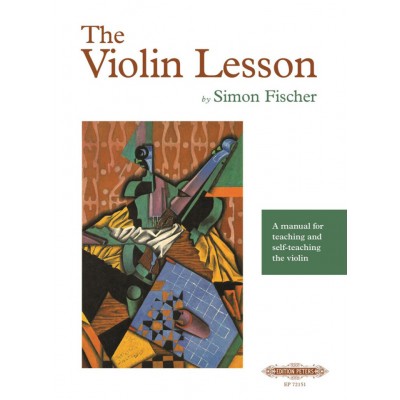
The Violin Lesson offers players of all standards the opportunity to immediately ? and dramatically ? improve their technique and understanding of violin playing. Presented in twelve comprehensive and highly accessiblelessons filled with more than 500 music examples and over 350 photographs, it provides fresh approaches to neglected aspects of playing whilst covering all the major areas of violin technique, including: toneproduction intonation avoiding aches and pains changing position improving bow strokes vibratoWhether outlining a basic concept or anadvancedtechnique, each topic is handled with the clarity and attention to detail for which Simon Fischer is so highly regarded. Fundamental exercises, principles and practice methods sit alongside case studies and practicalquestion-and-answer sections to present a truly rounded volume ? essential reading for both students and teachers alike. / Violon / Edition Peters
Par SILVERMAN ROB. Intended for the beginning drum student, this book contains m...(+)
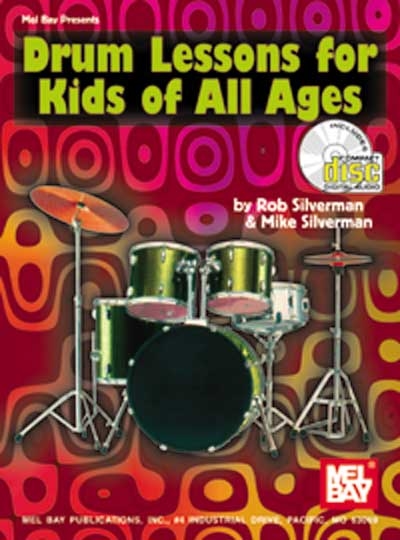
Par SILVERMAN ROB. Intended for the beginning drum student, this book contains many essential reading and playing skills for the snare and drumset. These studies are integrated in a logical, sequential order. For example, a new rhythm is introduced and studied on the snare drum, then later applied as a beat and then a fill. The same rhythm will appear later in the book for review and then in one of the play-along tunes. This way each concept is reinforced and utilized in different ways. Because of the need to stress the importance of dynamics and their role in the proper execution of playing a piece, dynamic markings are included in many of the snare drum exercises. The author has gone to extreme measures to provide a fun and humorous way of learning to play drums while at the same time implementing the fundamental tools necessary to be a proficient musician. The companion CD presents eight play-along tunes with and without the drums. / Niveau : Débutant à Intermédiaire / Rock and Jazz - Methods / Méthode / Batterie
Par BOONSHAFT PETER. Sound Artistry supports musical growth, enhancing technical...(+)
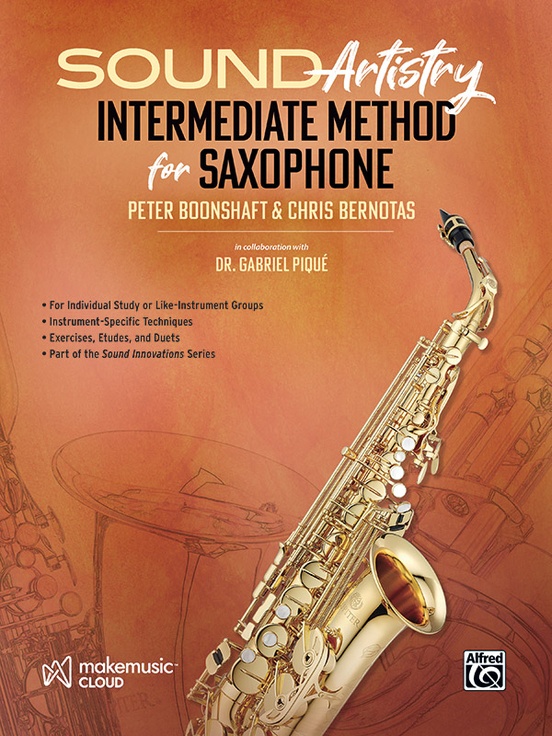
Par BOONSHAFT PETER. Sound Artistry supports musical growth, enhancing technical and expressive skills. Backed by collaborative partners and specialist teachers, this comprehensive book features lessons suitable for intermediate to advanced players with a focus on instrument-specific exercises---perfect for use after any method book to bridge the gap to instrument-specific conservatory methods. It emphasizes skill reinforcement, individual progress, and diverse exercises including scales, arpeggios, technical exercises, etudes, and duets. This book progresses through various meters and every key and includes a detailed fingering chart. Elevate your musicianship, technique, and artistry with this valuable resource, part of the revolutionary Sound Innovations series. This book is for all saxophones: soprano, alto, tenor, and baritone saxophone. Sound Artistry Intermediate Method for Saxophone focuses on skills that all intermediate saxophone players need to develop. Some highlights of the skills and concepts included are: * Tone and intonation * Venting and covering * Side C and B-flat * Embouchure and range development * Alternate fingerings * Vibrato * Note bending * Grace notes * Trills * Flexibility * Phrasing * Tips for success. This book is for all saxophones (soprano, alto, tenor, and baritone saxophone). Written by Peter Boonshaft and Chris Bernotas in collaboration with Dr. Gabriel Piqué, Assistant Professor of Saxophone and Jazz Studies, Baldwin Wallace University---Conservatory of Music. / Date parution : 2025-05-20/ Méthode / Saxophone
Par BOONSHAFT PETER. Sound Artistry supports musical growth, enhancing technical...(+)
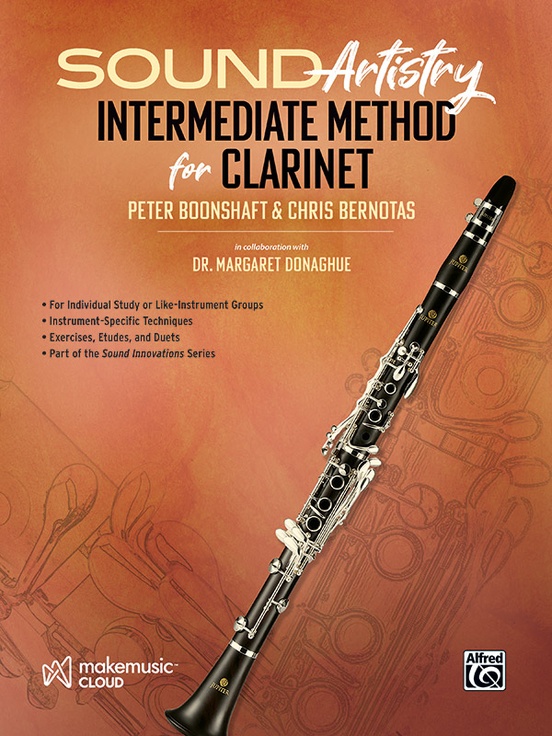
Par BOONSHAFT PETER. Sound Artistry supports musical growth, enhancing technical and expressive skills. Backed by collaborative partners and specialist teachers, this comprehensive book features lessons suitable for intermediate to advanced players with a focus on instrument-specific exercises---perfect for use after any method book to bridge the gap to instrument-specific conservatory methods. It emphasizes skill reinforcement, individual progress, and diverse exercises including scales, arpeggios, technical exercises, etudes, and duets. This book progresses through various meters and every key and includes a detailed fingering chart. Elevate your musicianship, technique, and artistry with this valuable resource, part of the revolutionary Sound Innovations series. Sound Artistry Intermediate Method for Clarinet focuses on skills that all intermediate clarinet players need to develop. Some highlights of the skills and concepts included are: * Tone and intonation * Left and right pinky keys * Resonance fingerings * Chalumeau register * Altissimo register * Chromatic fingerings and 1 1 B-flat * Break studies * Fingering suggestions * Grace notes * Trills * Flexibility * Phrasing * Tips for success. Written by Peter Boonshaft and Chris Bernotas in collaboration with Dr. Margaret Donaghue, Professor of Clarinet and Director of the Woodwind Program, Frost School of Music (University of Miami). / Date parution : 2025-05-20/ Méthode / Clarinette
An Elementary Method. Par WAGNER ERNEST. Ernest Frederick Wagner's Foundation to...(+)
An Elementary Method. Par WAGNER ERNEST. Ernest Frederick Wagner's Foundation to Flute Playing is an exceptional instructional guide that caters to the needs of both novice and seasoned flutists. This comprehensive book offers technique drills and musically challenging short pieces to help learners progress from medium-easy exercises to more complex compositions. The book provides a detailed guide on fundamental adjustments and care for the instrument and meticulously outlines lessons on fingering, rhythm, and tuning. Various lessons, including scale studies, articulate tonguing exercises, syncopation rhythms, staccato practices, and embouchure strengthening exercises, will help train agility and precision. Whether you are a beginner or an advanced flutist, this book is designed to help you achieve technical excellence and musical mastery. / Date parution : 2025-01-21/ Méthode / Flûte Traversière
This second volume in the Classical Piano Solos series features 22 original piec...(+)
This second volume in the Classical Piano Solos series features 22 original pieces from the masters, suitable for pianists at a Grade 2 standard.This series was compiled to correlate loosely with the Modern Course method and can be used to supplement any teaching method or situation. This volume features a mix of well-known pieces such as Petzold's 'Minuet in G Major? from the Anna Magdelena Notebook, Schumann's 'Soldier's March,? and Beethoven's 'Ecossaise in G Major? as well as lesser-known gems like d'Indy's modern 'Three-Finger Partita? and Rebikov's ominous 'Limping Witch Lurking in the Woods.? / Piano
This third volume in the Classical Piano Solos series features 20 original piece...(+)
This third volume in the Classical Piano Solos series features 20 original pieces from the masters, suitable for pianists at a Grade 3 standard.This series was compiled to correlate loosely with the Modern Course method and can be used to supplement any teaching method or situation. This volume features a mix of well-known pieces such as Burgmüller's 'Ballade? and Rebikov's 'Playing Soldiers? as well as lesser-known gems like CPE Bach's 'Presto? - a fast, motivating recital piece, and the lovely, lyrical 'Piece Romantique? by Cecile Chaminade. / Piano
Par SAGRERAS JULIO SALVADOR. One of the world's most popular beginning classical...(+)
Par SAGRERAS JULIO SALVADOR. One of the world's most popular beginning classical guitar methods by South American guitar virtuoso Julio Sagreras and translated by Bernard Moore. Features carefully sequenced studies covering technique and theory through music etudes and pieces./ Méthode / Guitare
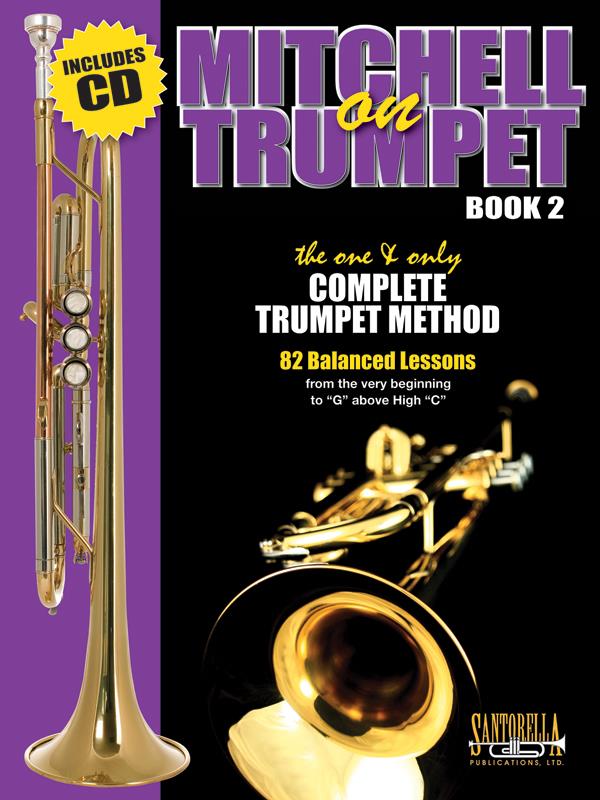
Par MITCHELL HAROLD. Mitchell on Trumpet is revered by educators around the glob...(+)
Par MITCHELL HAROLD. Mitchell on Trumpet is revered by educators around the globe and stands unequalled by any other published approach for trumpet. This proven curriculum will guide any ambitious student on a path towards performance excellence. It takes you from the beginning to the extreme limits of the horn through a gradual progression of 82 balanced lessons developing your range from low F-sharp to G above high C. Mitchell on Trumpet - Book 2 continues this exciting journey with Lesson 27 and introduces many advanced concepts while extending the student's range to High C. The exercises and studies cover all phases of playing with the ultimate goal of acquiring and maintaining a strong flexible embouchure. Los Angeles studio pro, Chris Tedesco, will guide you through selected excerpts from all 19 lessons (#27 through #45) by playing, demonstrating, and encouraging the student from start to finish on the included audio CD. Pappy often said, 'Perfect practice makes perfect, careless practice makes mediocrity, and no practice makes nothing.' Since every individual has their own unique set of strengths and challenges, the time necessary to devote to studying this method will vary from student to student. The important thing is to establish a structured schedule that is appropriate for you. There are countless professionals, educators, and performers who claim that Mitchell on Trumpet is the most complete trumpet method ever written. The student who completes Mitchell's Method will be among a select few who possess the endurance, technique, and flexibility needed to conquer any obstacle that they may encounter in any musical passage ever written for trumpet. This Book 2 and all that follow are dedicated to Harold's son, Ollie Mitchell for his tireless pursuit to see his Pappy's work available for many future generations of aspiring trumpet players. Ollie touched so many lives, but sadly, was peacefully reunited with his Pappy when he passed away at home surrounded by family and friends on May 11, 2013. Harold Mitchell lived during a time when musicians played a vital role in popular entertainment. It was a nostalgic era of live performances in music & theater. Mitchell on Trumpet is the culmination of Pappy's life's work and still remains today as the only complete course ever written for learning to play the trumpet./ Méthode / Trompette
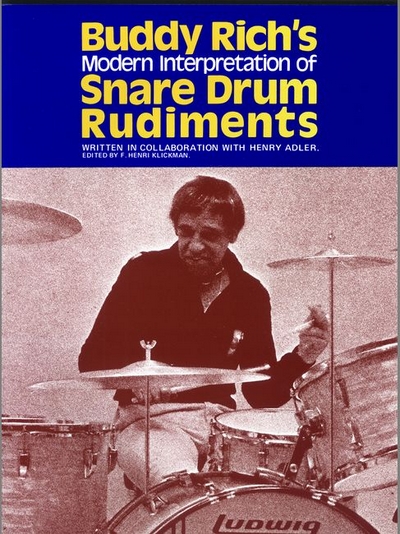
Par RICH BUDDY. This method is the result of the Rich/Adler partnership, contain...(+)
Par RICH BUDDY. This method is the result of the Rich/Adler partnership, containing all the fundamentals material needed for an instructive drum method. In addition to the elementary principles of music, there are 83 lessons of exercises and rudiments, 21 reading exercises, 10 exercises employing rudiments, 46 six advanced rhythmic studies and a list of most frequently used musical terms. All the material has been carefully graded as to difficulty. / Niveau : Débutant / Méthode / Batterie
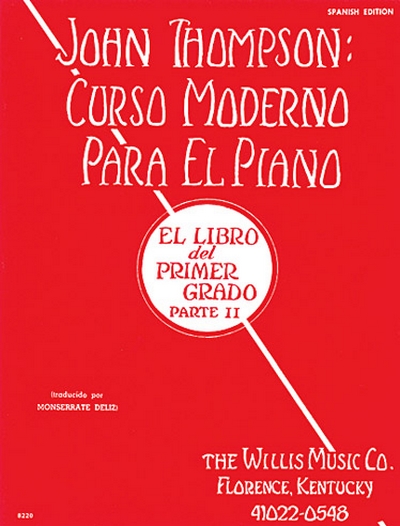
Spanish Edition. Par THOMPSON JOHN. John Thompsons modern course for the Piano i...(+)
Spanish Edition. Par THOMPSON JOHN. John Thompsons modern course for the Piano is the essential Piano method for beginner students of all ages. Clearly written, fun and easy to understand, the Modern Course is a proven favourite with Piano teachers and students worldwide, withmillions of copies sold. This updated 2012 edition has updated diagrams, clearer musical notation and improved overall design. John Thompson's modern course for the Piano is the essential Piano method for beginner students of all ages. Clearly written, fun and easy to understand, the Modern Course is a proven favourite with Piano teachers and students worldwide, with millions of copies sold. This updated 2012 edition has updated diagrams, clearer musical notation and improved overall design. Following directly on from the First Grade book, this second grade book provides: Over 50 arrangements of classical pieces and folk songs A CD containing backing tracks and performances of each piece Helpful technical exercises andstudies Fundamental lessons on scales and music theory Helping students to both think and feel musically, the Modern Course is the most effective and enjoyable way to learn the Piano. Spanish language edition. / Pédagogie / Méthode / Piano
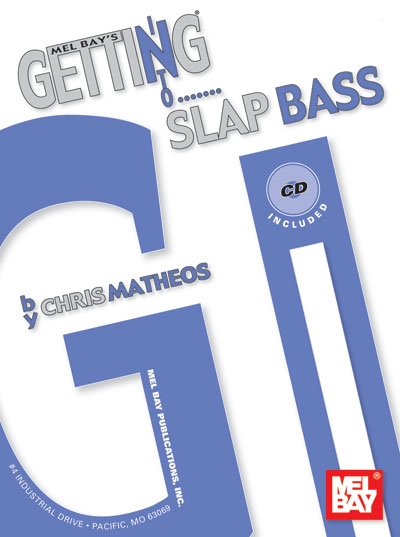
Par MATHEOS CHRIS. Everything is covered here - starting with all the basics lik...(+)
Par MATHEOS CHRIS. Everything is covered here - starting with all the basics like octaves, hammer-ons and pull-offs. It then builds into the most advanced slap techniques including double and triple pops, flamenco thumb technique, and plucks. There are lessons in upright bass slap, as well as modal harmony studies. The grooves cover a wide range of styles that include jazz fusion, walking lines, fingerstyle conversion, pop/dance, funk/soul, bluegrass, Dixieland, etc. These lessons have something for almost any student - written in bass clef and tablature with CD. / Niveau : Débutant / Rock - Methods / Tablatures / Guitare Basse Tablatures
Any violinist who hears the name Sitt nowadays will probably just think of the a...(+)
Any violinist who hears the name Sitt nowadays will probably just think of the author of studies and exercises that have long been a familiar feature in instrumental lessons. Of course the Prague violinist, music teacher and composer Hans Sitt (1850-1922) made a significant impact on methods of violin teaching, but he also wrote a whole series of other works worth listening to: concertos for violin, viola and cello and chamber music for various combinations of instruments. Sitt studied the violin in Prague and was then appointed first as leader of the orchestra and then as musical director in Breslau (now called Wroc?aw).After posts as director of music in Prague, Chemnitz - where he championed the work of Smetana - and Nice, he was eventually appointed professor of violin, orchestral playing and score reading at the Leipzig Conservatoire from 1884-1921. Besides this he also played viola in the Brodsky Quartet, organised concerts and was conductor of the Bach Society. The composers Franco Alfano - who completed Puccini's unfinished opera Turandot- and Frederick Delius studied with Sitt, as did the conductor Václav Talich. Three Album Leaves op. 13 were also composed during his time in Leipzig, published by Bosworth and Co in 1894. Romanesca, #1 in that collection, is a pretty, slightly melancholy piece of music with romantic appeal that draws out lyrical and expressive playing and is thus eminently suitable for tuition purposes and concert performances. / Violon Et Piano