Concert Pieces from the Clarinet Method. Par BAERMANN CARL. The clarinet method ...(+)
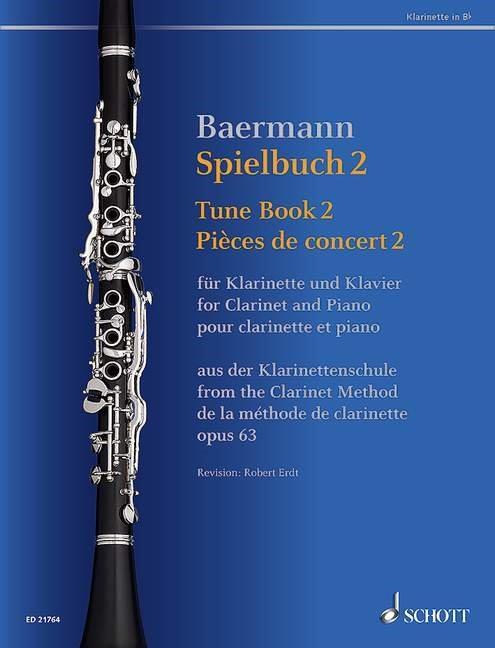
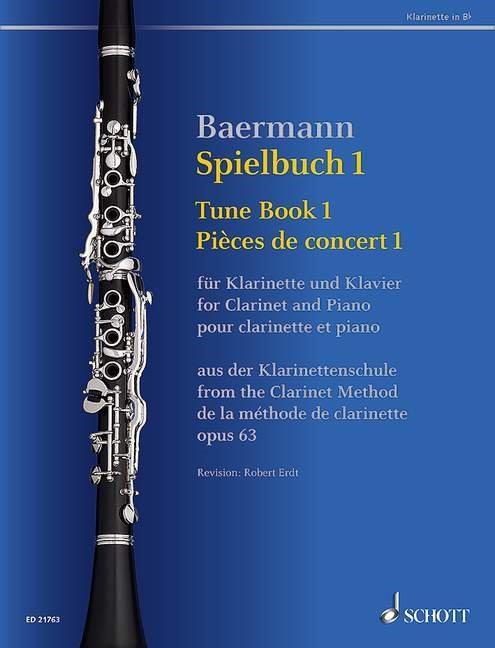
Concert Pieces from the Clarinet Method. Par BAERMANN CARL. The clarinet method op. 63 by Carl Baermann from 1867 is still a standard work in classical clarinet education today. The thoroughly revised new edition aims at reviewing the educational concept, which is still valid today, for modern lessons, adjusting the music and texts, and sensibly complementing the teaching contents.
The editor who draws on many years of experience as a clarinettist in an orchestra and university lecturer of clarinet has succeeded in adapting the valuable teaching material to the requirements of today while maintaining the basic methodology. The result is a total of 7 volumes:
Clarinet Method Vol. 1 and Vol. 2 (ED 21761, ED 21762)
Clarinet Method Vol. 1 and Vol. 2, with 2 CDs each (ED 21761-50, ED 21762-50): The CDs contain the piano accompaniment for the performance pieces, with and without clarinet
Tune Book 1 and 2 (ED 21763, ED 21764): piano score of the method\'s performance pieces, with additional inserted clarinet part
Daily Exercises (ED 21765): systematic scale, interval and chord exercises in all keys, complemented and published separately from the original method
Due to trilingual nature of all editions (German, English, French), they can be used universally.
About the revision:
The musical text is based on the first edition of the method. Only a few differences concerning the articulation as well as some misprints and typographical errors were revised. By deleting the historical fingering instructions for the German fingering system, the clarinet method not only has a clean and, compared to the original, more clearly structured layout, but can also be used universally. The content of the text and the performance directions of the original were linguistically modernized and occasionally extended by further ideas from the teaching practice, such as concepts for warming up, breathing exercises, literature suggestions or tips for daily practising. Further additions of scale and triad studies in all major and minor keys make this method a comprehensive and thorough work of study which not only serves as teaching material for young and adult beginners, but is also a valuable compendium of scale exercises and studies for advanced musicians and is ideal for training velocity and dexterity.
The tune books contain all performance pieces from the Clarinet Method Op. 63 by Carl Baermann for clarinet and piano. Thanks to the revised editions, they are now available as scores with inserted solo part for the first time. Thus, the popular performance pieces and studies can also be used separately from the textbook ? as an addition to the repertoire of music lessons or simply as a collection of attractive performance pieces for pupils and advanced clarinettists.
As with the two volumes of the Clarinet Method, the musical text of the tune books is based on the first edition of the method, and only few differences concerning articulation as well as several misprints and typographical errors were revised. By deleting the historical fingering instructions for the German fingering system, the clarinet method not only has a clean and, compared to the original, more clearly structured layout, but can also be used universally.
/ Éducatif / Recueil / Clarinette en Bb et Piano
Concert Pieces from the Clarinet Method. Par BAERMANN CARL. The clarinet method ...(+)
Concert Pieces from the Clarinet Method. Par BAERMANN CARL. The clarinet method op. 63 by Carl Baermann from 1867 is still a standard work in classical clarinet education today. The thoroughly revised new edition aims at reviewing the educational concept, which is still valid today, for modern lessons, adjusting the music and texts, and sensibly complementing the teaching contents.
The editor who draws on many years of experience as a clarinettist in an orchestra and university lecturer of clarinet has succeeded in adapting the valuable teaching material to the requirements of today while maintaining the basic methodology. The result is a total of 7 volumes:
Clarinet Method Vol. 1 and Vol. 2 (ED 21761, ED 21762)
Clarinet Method Vol. 1 and Vol. 2, with 2 CDs each (ED 21761-50, ED 21762-50): The CDs contain the piano accompaniment for the performance pieces, with and without clarinet
Tune Book 1 and 2 (ED 21763, ED 21764): piano score of the method\'s performance pieces, with additional inserted clarinet part
Daily Exercises (ED 21765): systematic scale, interval and chord exercises in all keys, complemented and published separately from the original method
Due to trilingual nature of all editions (German, English, French), they can be used universally.
About the revision:
The musical text is based on the first edition of the method. Only a few differences concerning the articulation as well as some misprints and typographical errors were revised. By deleting the historical fingering instructions for the German fingering system, the clarinet method not only has a clean and, compared to the original, more clearly structured layout, but can also be used universally. The content of the text and the performance directions of the original were linguistically modernized and occasionally extended by further ideas from the teaching practice, such as concepts for warming up, breathing exercises, literature suggestions or tips for daily practising. Further additions of scale and triad studies in all major and minor keys make this method a comprehensive and thorough work of study which not only serves as teaching material for young and adult beginners, but is also a valuable compendium of scale exercises and studies for advanced musicians and is ideal for training velocity and dexterity.
The tune books contain all performance pieces from the Clarinet Method Op. 63 by Carl Baermann for clarinet and piano. Thanks to the revised editions, they are now available as scores with inserted solo part for the first time. Thus, the popular performance pieces and studies can also be used separately from the textbook ? as an addition to the repertoire of music lessons or simply as a collection of attractive performance pieces for pupils and advanced clarinettists.
As with the two volumes of the Clarinet Method, the musical text of the tune books is based on the first edition of the method, and only few differences concerning articulation as well as several misprints and typographical errors were revised. By deleting the historical fingering instructions for the German fingering system, the clarinet method not only has a clean and, compared to the original, more clearly structured layout, but can also be used universally. / Éducatif / Recueil / Clarinette en Bb et Piano
These two collections (BA 9668, BA 9669) give young students and teachers a rich...(+)
These two collections (BA 9668, BA 9669) give young students and teachers a rich selection of recital pieces, either to complement the Sassmannshaus 'Early Start on the Violin? method or to play independently from it. As all the pieces are written entirely in first position, they can be used after just a few months of lessons.The piano part may be played by the teacher or an advanced student. As an alternative, the accompaniment can be played by a second violin.All the pieces are available in exemplary recordings on YouTube.From the contents of Volumes 1 and 2:Nursery rhymes, folksongs but also less well-known gems, as well as original pieces by the editors, all precisely tailored to meet the needs of young students.- New recital pieces for the tried and trusted Sassmannshaus violin method- All pieces written in first position- With a second violin part for duet performance- Available in freely accessible recordings on YouTubeKurt Sassmannshaus, the editor of a great many string editions in the Bärenreiter catalogue, continues the tradition founded by his father Egon Sassmannshaus in the 'Early Start? string methods. He developed these two new editions together with his wife Melissa Lusk and his son Christoph Sassmannshaus.Similar editions are in preparation for the cello. / Violon
These two collections (BA 9668, BA 9669) give young students and teachers a rich...(+)
These two collections (BA 9668, BA 9669) give young students and teachers a rich selection of recital pieces, either to complement the Sassmannshaus 'Early Start on the Violin? method or to play independently from it. As all the pieces are written entirely in first position, they can be used after just a few months of lessons.The piano part may be played by the teacher or an advanced student. As an alternative, the accompaniment can be played by a second violin.All the pieces are available in exemplary recordings on YouTube.From the contents of Volumes 1 and 2:Nursery rhymes, folksongs but also less well-known gems, as well as original pieces by the editors, all precisely tailored to meet the needs of young students.- New recital pieces for the tried and trusted Sassmannshaus violin method- All pieces written in first position- With a second violin part for duet performance- Available in freely accessible recordings on YouTubeKurt Sassmannshaus, the editor of a great many string editions in the Bärenreiter catalogue, continues the tradition founded by his father Egon Sassmannshaus in the 'Early Start? string methods. He developed these two new editions together with his wife Melissa Lusk and his son Christoph Sassmannshaus.Similar editions are in preparation for the cello. / Violon Et Piano