The clarinet method op. 63 by Carl Baermann from 1867 is still a standard work i...(+)
The clarinet method op. 63 by Carl Baermann from 1867 is still a standard work in classical clarinet education today. The thoroughly revised new edition aims at reviewing the educational concept, which is still valid today, for modern lessons, adjusting the music and texts, and sensibly complementing the teaching contents.The editor who draws on many years of experience as a clarinettist in an orchestra and university lecturer of clarinet has succeeded in adapting the valuable teaching material to the requirements of today while maintaining the basic methodology. The result is a total of 7 volumes:Clarinet Method Vol. 1 and Vol. 2 (ED 21761, ED 21762)Clarinet Method Vol. 1 and Vol. 2, with 2 CDs each (ED 21761-50, ED 21762-50): The CDs contain the piano accompaniment for the performance pieces, with and without clarinetTune Book 1 and 2 (ED 21763, ED 21764): piano score of the method's performance pieces, with additional inserted clarinet partDaily Exercises (ED 21765): systematic scale, interval and chord exercises in all keys, complemented and published separately from the original methodDue to trilingual nature of all editions (German, English, French), they can be used universally.About the revision:The musical text is based on the first edition of the method. Only a few differences concerning the articulation as well as some misprints and typographical errors were revised. By deleting the historical fingering instructions for the German fingering system, the clarinet method not only has a clean and, compared to the original, more clearly structured layout, but can also be used universally. The content of the text and the performance directions of the original were linguistically modernized and occasionally extended by further ideas from the teaching practice, such as concepts for warming up, breathing exercises, literature suggestions or tips for daily practising. Further additions of scale and triad studies in all major and minor keys make this method a comprehensive and thorough work of study which not only serves as teaching material for young and adult beginners, but is also a valuable compendium of scale exercises and studies for advanced musicians and is ideal for training velocity and dexterity.The Clarinet Method Vols. 1 and 2 contain not only scales and technical fingering exercises but also Baermann's popular performance pieces, like Romanze (No. 14), which are ideal as performance pieces, yet at the same time train both technique and musical expressiveness. The systematic scale, interval and chord exercises in all keys, however, were removed and are published separately in the volume Daily Exercises (ED 21765) for reasons of clarity.The two textbooks are available with or without CDs. The editions with CDs contain two audio CDs each which were recorded live by the editor and which contain a classic audio version of each performance piece as well as a pure piano version for playing along. / Clarinette
Par BOONSHAFT PETER. Sound Artistry supports musical growth, enhancing technical...(+)
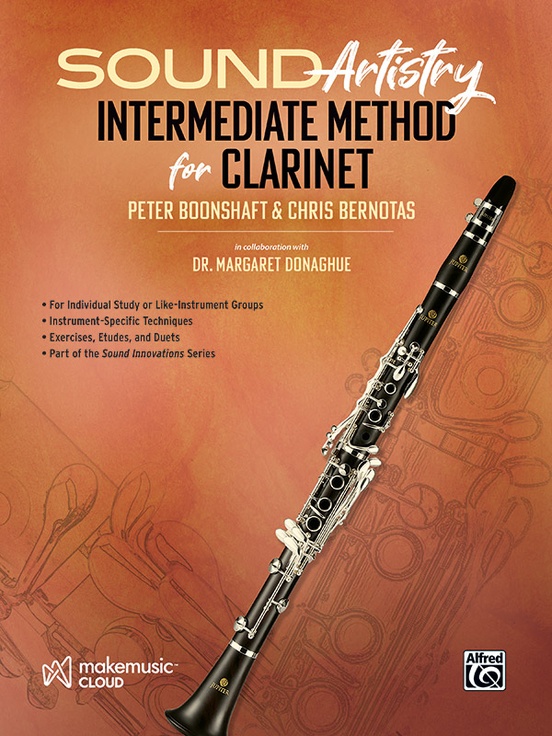
Par BOONSHAFT PETER. Sound Artistry supports musical growth, enhancing technical and expressive skills. Backed by collaborative partners and specialist teachers, this comprehensive book features lessons suitable for intermediate to advanced players with a focus on instrument-specific exercises---perfect for use after any method book to bridge the gap to instrument-specific conservatory methods. It emphasizes skill reinforcement, individual progress, and diverse exercises including scales, arpeggios, technical exercises, etudes, and duets. This book progresses through various meters and every key and includes a detailed fingering chart. Elevate your musicianship, technique, and artistry with this valuable resource, part of the revolutionary Sound Innovations series. Sound Artistry Intermediate Method for Clarinet focuses on skills that all intermediate clarinet players need to develop. Some highlights of the skills and concepts included are: * Tone and intonation * Left and right pinky keys * Resonance fingerings * Chalumeau register * Altissimo register * Chromatic fingerings and 1 1 B-flat * Break studies * Fingering suggestions * Grace notes * Trills * Flexibility * Phrasing * Tips for success. Written by Peter Boonshaft and Chris Bernotas in collaboration with Dr. Margaret Donaghue, Professor of Clarinet and Director of the Woodwind Program, Frost School of Music (University of Miami). / Date parution : 2025-05-20/ Méthode / Clarinette