Mel Bay Publications, Inc. est fière de vous présenter cette nouvelle série d...(+)
Mel Bay Publications, Inc. est fière de vous présenter cette nouvelle série de leçons dans le cadre de guitare atelier Audio série Stefan Grossman. Ce livre offre une vaste compilation des leçons de guitare finger-picking. Adresse de leçons : doigt renforcement exercices, le marteau sur et pull - off, single-chaîne s'exécute et contrepoint lignes, vibrato blues et syncopés basse et rythmiques licks - plus des lignes de basse marche, chromatique s'exécute, licks à chaud et les balises de fin. Ecrit en notation standard et tablature avec une explication complète du système de l'onglet. Comprend 3 CD / Guitare (Fingerpick) / 32 pages / niveau : Intermédiaire / Partition/3-Cd Set - Format: 11,75 X 8,75
For open-minded teachers and inquisitive kidsThese piano miniatures are a distin...(+)
For open-minded teachers and inquisitive kidsThese piano miniatures are a distinctive and unusual addition to the teaching literature - genre paintings in contrasting styles with musical wit and inventive sounds and rhythms. They offer glimpses into the musical cultures of different countries ('Hunting in Hungary, Gamelan, Balkan Dance, African Games?) and music history ('Medieval Feast for the Left-Handers?).Besides training finger technique, the pieces help students to think in terms of counterpoint and to develop an expressive delivery.Peter Graham (actually Jaroslav ?tastný, b. 1952) teaches composition at the Janácek Academy of Arts in Brno.- Miniature recital pieces for piano with amusing illustrations by Andrea Tachezy- A welcome addition to the piano teaching literature- Simple and entertaining genre paintings- Easy to moderate level of difficulty / Piano
Par BUSH ALAN. (GCSE/AL) This is one of the very few tried and tested manuals, b...(+)
Par BUSH ALAN. (GCSE/AL) This is one of the very few tried and tested manuals, by a much admired teacher, for those seeking instruction in the complex yet rewarding art of two-part species counterpoint. There are 55 exercises as well as many worked examples./ Livre / Livre
Romanticism through the Twelve-Tone Row. Par ULEHLA LUDMILA. The understanding o...(+)
Romanticism through the Twelve-Tone Row. Par ULEHLA LUDMILA. The understanding of the musical techniques of composition cannot be reduced to a handbook of simplified rules. Music is complex and ever changing. It is the purpose of this book to trace the path of musical growth from the late Romantic period to the serial techniques of the contemporary composer. Through the detailed analysis of the musical characteristics that dominate a specific style of writing, a graduated plan is organized and presented here in the form of explanations and exercises. A new analytical method substitutes for the diatonic figured bass and makes exercises and the analysis of non-diatonic literature more manageable. The explanations describing each technique are thorough. They are designed to help the teacher and the student see the many extenuating circumstances that affect a particular analytical decision. More important than a dogmatic decision on a particular key center or a root tone, for example, is the understanding of why such an underdeterminate condition may exist. / Date parution : 1994-06-06/ Théorie / Livre
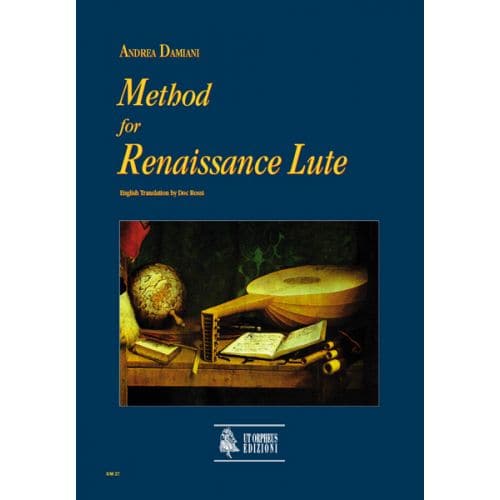
Traduction Doc Rossi Compositeur : Damiani Andrea Instrumentation : Luth Publication Date: 1999 Series: Teoria e Didattica della Musica (Theoretical and Educational Texts) Pages: pp. 208 CONTENTS * Preface * Introduction * CHAPTER 1. TUNING AND TABLATURE Tuning - Tablature (French tablature - Italian tablature - Rhythm symbols - Fingering and other symbols) - Stringing and doubling - Tuning practice (Practical advice on tuning - Tuning problems) - Strings * CHAPTER 2. BASIC TECHNIQUES Posture and position of the lute - Right-hand position - Right-hand functions - Sound production (Positioning p - Forearm movement - Attack - Positioning i) - Alternating p and i - Finger articulation for polyphonic passages (Positioning p - Positioning i) - Preparatory exercises - Differences from guitar technique - Body control * CHAPTER 3. THE RIGHT HAND Forearm and accentuation - Fingering * CHAPTER 4. THE LEFT HAND General principals - Preparatory exercises - Avoiding stiffness - Differences from guitar technique - Hand coordination * CHAPTER 5. SCALES Right-hand scale technique (Forearm movement - Finger articulation - Integrating the two techniques) * CHAPTER 6. EXERCISES FOR TWO LUTES Exercises on a ground bass - Contrapuntal exercises - Articulation - Dances and ground basses * CHAPTER 7. SHIFTING LEFT-HAND POSITIONS Fundamental principals - Position changes using the same finger - Position changes by substitution - Position changes by jump * CHAPTER 8. EXERCISES FOR TWO LUTES WITH POSITION CHANGES * CHAPTER 9. RIGHT-HAND TECHNIQUE IN POLYPHONIC MUSIC p-i articulation - Positioning m - Rest stroke with p - Left-hand positions and movement - m-i articulation - Combining p, i and m - Easy pieces in two voices - Two-voice scales * CHAPTER 10. COUNTERPOINT Voice progression and intervals - The species - Florid counterpoint - Imitation - Syncopation - Suspension * CHAPTER 11. CONTRAPUNTAL PIECES IN TWO VOICES * CHAPTER 12. THREE VOICES The right hand - Combining chords and single notes - Repeated chords and monophonic passages - Arpeggios - Chords and counterpoint * CHAPTER 13. CONTRAPUNTAL PIECES IN THREE VOICES Technical aspects: three-voice scales, the barre - Contrapuntal pieces in three voices * CHAPTER 14. CHORDS OF FOUR OR MORE NOTES The ring finger (a) - Five- and six-note chords - Chords played with p * CHAPTER 15. IDIOMATIC LUTE COMPOSITIONS Chords and divisions - Characteristics of lute composition * CHAPTER 16. TRANSFORMATION OF LUTE TECHNIQUE DURING THE 16th CENTURY Evolution of right-hand position - Exercises for m-i alternation * CHAPTER 17. TECHNIQUE Scales (Full-length scales in all keys - Scales with divisions) - Speed - Left-hand legato and ornamentation - The barre (Preparatory exercises - Barre exercises) - Scales in two and more voices (Two-voice scales - Three-voice scales) - Polyphonic patterns - Right-hand exercises * CHAPTER 18. RENAISSANCE PERFORMANCE PRACTICE Interpretation (Rhetoric - Sound quality - Rhythmic inequality) - Ornamentation (16th-century sources - The first half of the 16th century - The second half of the 16th century - The first half of the 17th century - The Elizabethans) * CHAPTER 19. TEMPERAMENT Meantone temperament - Equal temperament
Par MACPHERSON STEWART. The three books are published separately, although the a...(+)
Par MACPHERSON STEWART. The three books are published separately, although the author firmly believed that melodic movement and harmonic progression should always be studied side by side. Book 1 concentrates on single-line horizontal writing. The books employ exercises in counterpoint, in figured-bass harmony and in the roman-numeral inversion analysis./ Livre / Livre
An Intermediate-Level Guide with Step-by-Step Instructions. Par HENRY PAUL. The ...(+)
An Intermediate-Level Guide with Step-by-Step Instructions. Par HENRY PAUL. The Hal Leonard Classical Guitar Method is designed for anyone just learning to play classical guitar. This comprehensive and easy-to-use guide by renowned classical guitarist and teacher Paul Henry uses the music of the master composers to further develop your understanding of the classical style and technique. Book 2 includes: tone-coloring techniques; dynamics; dampening; sixth string tuned to D; notes above open position; left-hand shifting; grace notes, slides, and articulations; natural and artificial harmonics; natural and artificial harmonics; full and partial barres; trills and mordents; two-octave scales; vibrato; counterpoint; left- and right-hand technique review; slur exercises; and more! This book also includes access to more than 50 audio tracks for demonstration and play-along. Audio is accessed online using the unique code inside the book and can be streamed or downloaded. The audio files include PLAYBACK , a multi-functional audio player that allows you to slow down audio without changing pitch, set loop points, change keys, and pan left or right. / Date parution : 2022-07-23/ Méthode / Guitare
A Method for Keyboard Artists. Par . Improvising Fugue: A Method for Keyboard Ar...(+)
A Method for Keyboard Artists. Par . Improvising Fugue: A Method for Keyboard Artists is a guide for those who aspire to the highest levels of fluency as inventors of spontaneous music at the piano, fortepiano, harpsichord, organ, or digital keyboard. Written for professional performers, conservatory students, and devoted amateurs, this book leads the reader along the arduous journey from score dependency to improvisational freedom. Improvising Fugue begins with a comprehensive course in 18th century Italian partimento, the system of musicianship training that simultaneously strengthens improvisation, counterpoint, harmony, keyboard skills, and audiation. The reader then encounters fugue improvisation in a gradual, methodical, and rigorous manner. Every concept is accompanied by extensive and clear explanation, examples from music literature, and practical exercises. The book covers every aspect of fugue improvisation in depth, including subjects, countersubjects, tonal and real answers, episodes, presentations, pedal points, and stretti. Author John J. Mortensen draws on experience as a concert improviser on the international stage; the book's pragmatic, real-world instruction comes from a seasoned performer who knows firsthand exactly what is required to improvise fugues in the presence of a live audience. / Date parution : 2024-04-27/ Etude / Clavier
Par PENNANEN KEIJO. Among fretted-instrument players there is an expression that...(+)
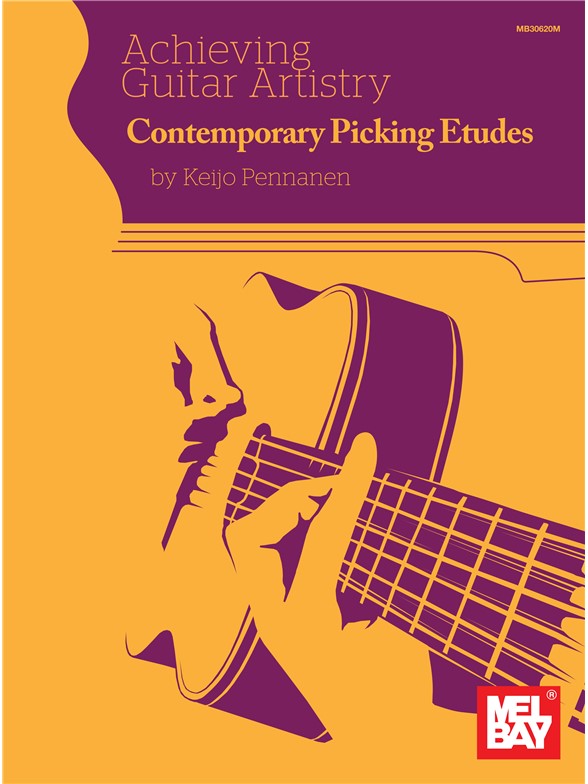
Par PENNANEN KEIJO. Among fretted-instrument players there is an expression that states, 'The fret hand marks a player, but the pick hand distinguishes an artist.'
The 23 original compositions in this book offer a fresh basis to explore and develop plectrum or pick-style playing technique to a professional level. These pieces require various playing techniques and include: linear studies, double-stops, counterpoint, and chord playing.
By studying and learning these pieces, guitarists can not only refine their technical mastery, but also enhance their skill level and artistry in solo guitar performance.
This collection also includes eight duet arrangements to be played by two guitarists. The duets are fun to play as student/teacher sight-reading exercises, and can be used as guitar duo performance repertoire as well.
The music is written in standard notation only. Access to online audio is included for all 31 pieces./ Etude / Guitare
Par MACPHERSON STEWART. The three books are published separately, although the a...(+)
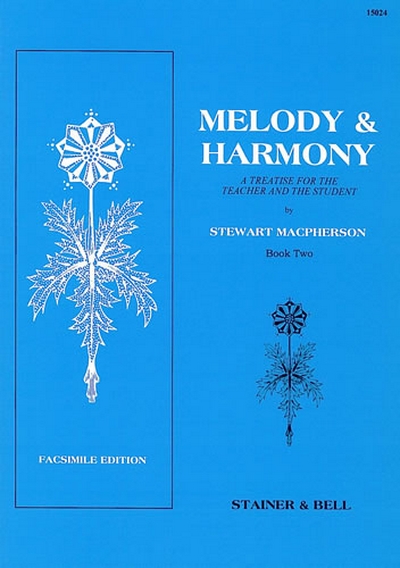
Par MACPHERSON STEWART. The three books are published separately, although the author firmly believed that melodic movement and harmonic progression should always be studied side by side. Book 2 teaches elementary harmonic progressions to use with your composed melodies. The books employ exercises in counterpoint, in figured-bass harmony and in the roman-numeral inversion analysis./ Livre / Livre
Par MACPHERSON STEWART. The three books are published separately, although the a...(+)
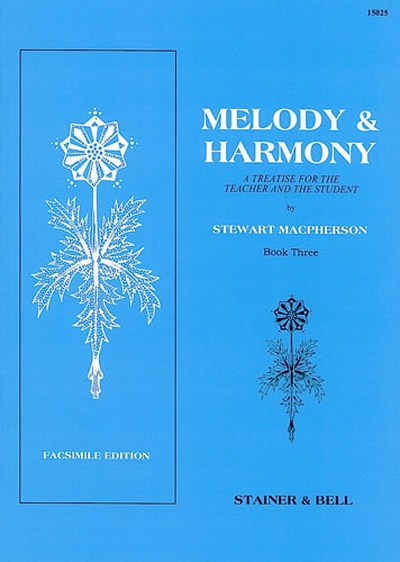
Par MACPHERSON STEWART. The three books are published separately, although the author firmly believed that melodic movement and harmonic progression should always be studied side by side. Book 3 describes more advanced harmony. The books employ exercises in counterpoint, in figured-bass harmony and in the roman-numeral inversion analysis./ Livre / Livre
Compiled and edited by Soós András. Par . This collection, similarly to the pu...(+)
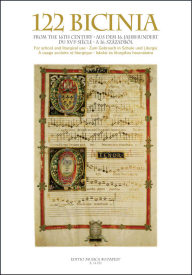
Compiled and edited by Soós András. Par . This collection, similarly to the publication entitled 111 bicinia from the 15th century (EMB 14478), contains longer and shorter two-part excerpts from polyphonic ecclesiastical choral works, for pedagogical and liturgical use. As teaching material, on the one hand it introduces and notes in brief textual definitions the characteristics of each given excerpt: on the other hand, it provides easily usable examples for teaching music history, solfege and counterpoint (practice of intervals, score-reading, dictation, stylistic exercises, etc.) At the same time the movements, which also function as independent units, can be quickly learnt, and may on occasions add colour to the musical palette of the liturgy by introducing material that can be performed even by a children's choir. The volume consists mainly of excerpts taken from Mass movements and Magnificats by Palestrina, Lassus, Gombert, Clemens non Papa and others. A separate chapter is devoted to chorale-based bicinia in German, which were already popular in the initial period of Evangelical church music. / Classique / Recueil / Voix A Cappella
Par HORNE GREG. Le dernier volume de cette superbe série consacrée à la guita...(+)
Par HORNE GREG. Le dernier volume de cette superbe série consacrée à la guitare acoustique commence par des exercises vous permettant de développer vitesse et précision. Des techniques telles que ' l'effet mitraillette ', l'étouffement main droite, le slap, le tapping, les harmoniques slappées st le trémolo sont étudiées. Vous approfondirez la musique celtique, le blues, l'improvisation modale, les accordages alternatifs, et vous apprendrez à jouer les styles dits de Musique du Monde tels que le reggae, la musique africaine, brézilienne, le norteno ou encore le conjunto. Cette méthode très pointue pour guitaristes intermediares et avancés inclut également une étude de plus de 10 accordages alternatifs et enseigne l'analyse, le contrepoint et le mouvement de voies. Tout guitariste, du musicien moyen au professionnel trouvera dans ce livre matière à améliorer son jeu de guitare acoustique. / Niveau : Avancé / Méthode / Guitare