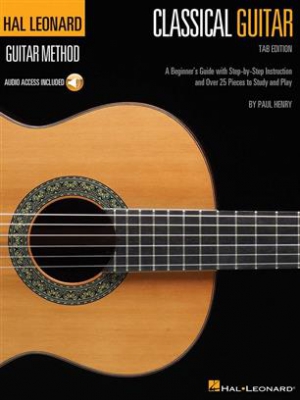
The Hal Leonard Classical Guitar Method is designed for anyone just learning to play classical Guitar. This comprehensive and easy-to-use beginner's guide by renowned classical guitarist and teacher P... Lire plus
The Hal Leonard Classical Guitar Method is designed for anyone just learning to play classical Guitar. This comprehensive and easy-to-use beginner's guide by renowned classical guitarist and teacher Paul Henry uses the music of the master composers to teach you the basics of the classical style and technique.The book includes pieces by Beethoven, Bach, Mozart, Schumann, Purcell and many more and includes lessons on:TuningProper playing techniqueNotes in open positionPIMA techniqueTime signaturesKey signaturesScalesChordsand more.Includes access to audio demo tracks online for download or streaming. / Guitare
Concert Pieces from the Clarinet Method. Par BAERMANN CARL. The clarinet method op. 63 by Carl Baermann from 1867 is still a standard work in classical clarinet education today. The thoroughly revised... Lire plus
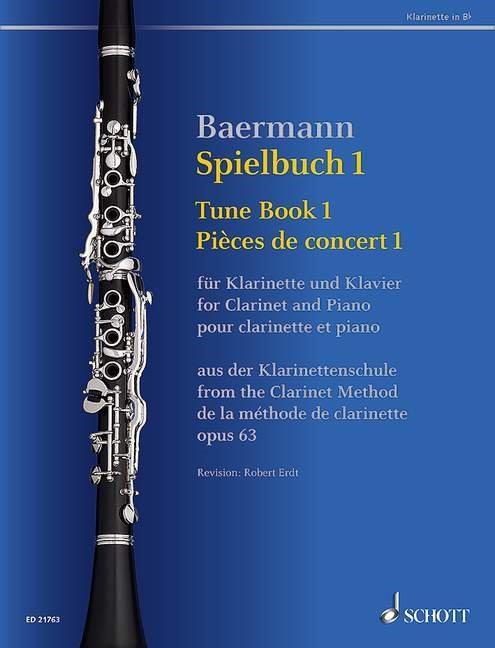
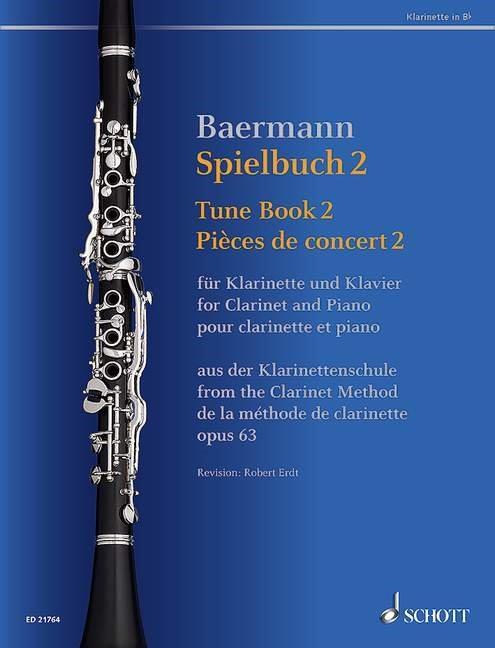
Concert Pieces from the Clarinet Method. Par BAERMANN CARL. The clarinet method op. 63 by Carl Baermann from 1867 is still a standard work in classical clarinet education today. The thoroughly revised new edition aims at reviewing the educational concept, which is still valid today, for modern lessons, adjusting the music and texts, and sensibly complementing the teaching contents.
The editor who draws on many years of experience as a clarinettist in an orchestra and university lecturer of clarinet has succeeded in adapting the valuable teaching material to the requirements of today while maintaining the basic methodology. The result is a total of 7 volumes:
Clarinet Method Vol. 1 and Vol. 2 (ED 21761, ED 21762)
Clarinet Method Vol. 1 and Vol. 2, with 2 CDs each (ED 21761-50, ED 21762-50): The CDs contain the piano accompaniment for the performance pieces, with and without clarinet
Tune Book 1 and 2 (ED 21763, ED 21764): piano score of the method\'s performance pieces, with additional inserted clarinet part
Daily Exercises (ED 21765): systematic scale, interval and chord exercises in all keys, complemented and published separately from the original method
Due to trilingual nature of all editions (German, English, French), they can be used universally.
About the revision:
The musical text is based on the first edition of the method. Only a few differences concerning the articulation as well as some misprints and typographical errors were revised. By deleting the historical fingering instructions for the German fingering system, the clarinet method not only has a clean and, compared to the original, more clearly structured layout, but can also be used universally. The content of the text and the performance directions of the original were linguistically modernized and occasionally extended by further ideas from the teaching practice, such as concepts for warming up, breathing exercises, literature suggestions or tips for daily practising. Further additions of scale and triad studies in all major and minor keys make this method a comprehensive and thorough work of study which not only serves as teaching material for young and adult beginners, but is also a valuable compendium of scale exercises and studies for advanced musicians and is ideal for training velocity and dexterity.
The tune books contain all performance pieces from the Clarinet Method Op. 63 by Carl Baermann for clarinet and piano. Thanks to the revised editions, they are now available as scores with inserted solo part for the first time. Thus, the popular performance pieces and studies can also be used separately from the textbook ? as an addition to the repertoire of music lessons or simply as a collection of attractive performance pieces for pupils and advanced clarinettists.
As with the two volumes of the Clarinet Method, the musical text of the tune books is based on the first edition of the method, and only few differences concerning articulation as well as several misprints and typographical errors were revised. By deleting the historical fingering instructions for the German fingering system, the clarinet method not only has a clean and, compared to the original, more clearly structured layout, but can also be used universally.
/ Éducatif / Recueil / Clarinette en Bb et Piano
Concert Pieces from the Clarinet Method. Par BAERMANN CARL. The clarinet method op. 63 by Carl Baermann from 1867 is still a standard work in classical clarinet education today. The thoroughly revised... Lire plus
Concert Pieces from the Clarinet Method. Par BAERMANN CARL. The clarinet method op. 63 by Carl Baermann from 1867 is still a standard work in classical clarinet education today. The thoroughly revised new edition aims at reviewing the educational concept, which is still valid today, for modern lessons, adjusting the music and texts, and sensibly complementing the teaching contents.
The editor who draws on many years of experience as a clarinettist in an orchestra and university lecturer of clarinet has succeeded in adapting the valuable teaching material to the requirements of today while maintaining the basic methodology. The result is a total of 7 volumes:
Clarinet Method Vol. 1 and Vol. 2 (ED 21761, ED 21762)
Clarinet Method Vol. 1 and Vol. 2, with 2 CDs each (ED 21761-50, ED 21762-50): The CDs contain the piano accompaniment for the performance pieces, with and without clarinet
Tune Book 1 and 2 (ED 21763, ED 21764): piano score of the method\'s performance pieces, with additional inserted clarinet part
Daily Exercises (ED 21765): systematic scale, interval and chord exercises in all keys, complemented and published separately from the original method
Due to trilingual nature of all editions (German, English, French), they can be used universally.
About the revision:
The musical text is based on the first edition of the method. Only a few differences concerning the articulation as well as some misprints and typographical errors were revised. By deleting the historical fingering instructions for the German fingering system, the clarinet method not only has a clean and, compared to the original, more clearly structured layout, but can also be used universally. The content of the text and the performance directions of the original were linguistically modernized and occasionally extended by further ideas from the teaching practice, such as concepts for warming up, breathing exercises, literature suggestions or tips for daily practising. Further additions of scale and triad studies in all major and minor keys make this method a comprehensive and thorough work of study which not only serves as teaching material for young and adult beginners, but is also a valuable compendium of scale exercises and studies for advanced musicians and is ideal for training velocity and dexterity.
The tune books contain all performance pieces from the Clarinet Method Op. 63 by Carl Baermann for clarinet and piano. Thanks to the revised editions, they are now available as scores with inserted solo part for the first time. Thus, the popular performance pieces and studies can also be used separately from the textbook ? as an addition to the repertoire of music lessons or simply as a collection of attractive performance pieces for pupils and advanced clarinettists.
As with the two volumes of the Clarinet Method, the musical text of the tune books is based on the first edition of the method, and only few differences concerning articulation as well as several misprints and typographical errors were revised. By deleting the historical fingering instructions for the German fingering system, the clarinet method not only has a clean and, compared to the original, more clearly structured layout, but can also be used universally. / Éducatif / Recueil / Clarinette en Bb et Piano
Par . Part of the Anglo Music Play-along Series, Philip Sparke’s 15 Easy Classical Solos is aimed at the young instrumentalist who can play just over an octave. Specifically tailored to suit the ind... Lire plus
Par . Part of the Anglo Music Play-along Series, Philip Sparke’s 15 Easy Classical Solos is aimed at the young instrumentalist who can play just over an octave. Specifically tailored to suit the individual instrument, this book introduces the beginning player to the world of the classics by using simple yet attractive melodies that fit their limited range. The carefully selected pieces include music from the 16th to the 20th century and cover a wide variety of styles, from Bach to Grieg and from Purcell to Satie. This book will provide invaluable additional material to complement any teaching method and includes both piano accompaniment and an online audio / Date parution : 2025-11-18/ Recueil / Cor Français et Piano
These two collections (BA 9668, BA 9669) give young students and teachers a rich selection of recital pieces, either to complement the Sassmannshaus 'Early Start on the Violin? method or to play indep... Lire plus
These two collections (BA 9668, BA 9669) give young students and teachers a rich selection of recital pieces, either to complement the Sassmannshaus 'Early Start on the Violin? method or to play independently from it. As all the pieces are written entirely in first position, they can be used after just a few months of lessons.The piano part may be played by the teacher or an advanced student. As an alternative, the accompaniment can be played by a second violin.All the pieces are available in exemplary recordings on YouTube.From the contents of Volumes 1 and 2:Nursery rhymes, folksongs but also less well-known gems, as well as original pieces by the editors, all precisely tailored to meet the needs of young students.- New recital pieces for the tried and trusted Sassmannshaus violin method- All pieces written in first position- With a second violin part for duet performance- Available in freely accessible recordings on YouTubeKurt Sassmannshaus, the editor of a great many string editions in the Bärenreiter catalogue, continues the tradition founded by his father Egon Sassmannshaus in the 'Early Start? string methods. He developed these two new editions together with his wife Melissa Lusk and his son Christoph Sassmannshaus.Similar editions are in preparation for the cello. / Violon
These two collections (BA 9668, BA 9669) give young students and teachers a rich selection of recital pieces, either to complement the Sassmannshaus 'Early Start on the Violin? method or to play indep... Lire plus
These two collections (BA 9668, BA 9669) give young students and teachers a rich selection of recital pieces, either to complement the Sassmannshaus 'Early Start on the Violin? method or to play independently from it. As all the pieces are written entirely in first position, they can be used after just a few months of lessons.The piano part may be played by the teacher or an advanced student. As an alternative, the accompaniment can be played by a second violin.All the pieces are available in exemplary recordings on YouTube.From the contents of Volumes 1 and 2:Nursery rhymes, folksongs but also less well-known gems, as well as original pieces by the editors, all precisely tailored to meet the needs of young students.- New recital pieces for the tried and trusted Sassmannshaus violin method- All pieces written in first position- With a second violin part for duet performance- Available in freely accessible recordings on YouTubeKurt Sassmannshaus, the editor of a great many string editions in the Bärenreiter catalogue, continues the tradition founded by his father Egon Sassmannshaus in the 'Early Start? string methods. He developed these two new editions together with his wife Melissa Lusk and his son Christoph Sassmannshaus.Similar editions are in preparation for the cello. / Violon Et Piano
18 Recital Pieces in First Position for Cello and Piano or Two Celli. The 18 pieces in Volume 1 are structured to follow the same progression of finger patterns introduced in the 'Early” Start metho... Lire plus
18 Recital Pieces in First Position for Cello and Piano or Two Celli. The 18 pieces in Volume 1 are structured to follow the same progression of finger patterns introduced in the 'Early” Start method. This systematic progression helps the student to solidify the hand position and improve intonation. The basic bowing techniques do not require changes in bow speed or sounding point. The young performer can focus on a straight and beautifully placed bow that produces a pleasing and clear sound.
The 'Cello Recital Album”, Volume 1 (BA 8994), can be used as a supplement to the 'Early Start on the Cello” method, Volumes 1 and 2 (BA 8996 and BA 8997).
Collections of recital pieces for the cello:
- Charming collections of easy pieces in first position
- Each cello part is supported by a piano accompaniment for student performances
- Alternately a second cello part allows duo playing with the teacher during lessons. This early introduction to chamber music brings joy and satisfaction to the young cellist and teaches the student to hear the music as a whole.
- The two volumes (BA 8994, Ba 8995) are designed as companion publications to the Early Start on the Cello method. However, they work equally well as a supplement to any other cello method.
- A variety of rarely published works by well-known cellists and pedagogues such as Wilhelm Fitzenhagen, Hugo Schlemüller, and August Nölck make these publications attractive to teachers and students.
/ Recueil / Violoncelle et Piano
The 12 pieces in Volume 2 are structured to follow the same progression of finger patterns introduced in the 'Early Start? method, Volumes 2 and 3. The later repertoire in this volume includes a caref... Lire plus
The 12 pieces in Volume 2 are structured to follow the same progression of finger patterns introduced in the 'Early Start? method, Volumes 2 and 3. The later repertoire in this volume includes a careful introduction of downward and upward extensions.The 'Cello Recital Album?, Volume 2 (BA 8995), can be used as a supplement to the 'Early Start on the Cello? method, Volumes 2 and 3 (BA 8997 and BA 8998).Collections of recital pieces for the cello: - Charming collections of easy pieces in first position - Each cello part is supported by a piano accompaniment for student performances - Alternately a second cello part allows duo playing with the teacher during lessons. This early introduction to chamber music brings joy and satisfaction to the young cellist and teaches the student to hear the music as a whole. - The two volumes (BA 8994, Ba 8995) are designed as companion publications to the Early Start on the Cello method. However, they work equally well as a supplement to any other cello method. - A variety of rarely published works by well-known cellists and pedagogues such as Wilhelm Fitzenhagen, Hugo Schlemüller, and August Nölck make these publications attractive to teachers and students. / Violoncelle Et Piano
With the new Urtext Primo series, the Wiener Urtext Edition wants to close the gap arising at the point of transition to additional lessons after having studied a piano method. Beginning with a perfor... Lire plus
With the new Urtext Primo series, the Wiener Urtext Edition wants to close the gap arising at the point of transition to additional lessons after having studied a piano method. Beginning with a performance level which is outlined by pieces such as Bach's Minuet in G (BWV Anh. 116), Mozart's Minuet in F (KV 5) or Schumann's Wilder Reiter (Op. 68/8), works by three different composers are selected for each volume of the Urtext Primo series, with the aim of offering piano pupils (or even adults who want to resume piano playing) a wide range of repertoire pieces on the basis of which they can enhance their technical and musical skills. The pieces' range of levels of difficulty is relatively narrow so that the volume can be used continuously over a period of about two years. This is what distinguishes the Urtext Primo approach from almost all common anthologies. The selected repertoire takes into account not only pieces of the classic canon of lessons, but also lesser known works which are in no way of less importance for piano lessons. The Urtext Primo volumes are published in the internationally recognised standard of the Wiener Urtext editions. The explanations included in each volume shall help to deepen the knowledge of musical styles, music history and piano playing. A repertoire chart at the end of each volume gives a rough overview of the levels of difficulty of the selected pieces.Volume 4 combines works of the German Romanticism by Schumann, Brahms and Theodor Kirchner. Apart from well known pieces from Schumann's 'Album for the Youth' and the easiest waltzes from opus 39 (in the easier version) by Brahms, the selection contains the attractive set of variations from Schumann's first Youth Sonata Op. 118/1 and Brahms' Saraband in A minor WoO 5/1 as well as a number of pleasant pieces by Theodor Kirchner which continue the tonal air of Schumann and Brahms in easy playable pieces. / Piano
With the new Urtext Primo series, the Wiener Urtext Edition wants to close the gap arising at the point of transition to additional lessons after having studied a piano method. Beginning with a perfor... Lire plus
With the new Urtext Primo series, the Wiener Urtext Edition wants to close the gap arising at the point of transition to additional lessons after having studied a piano method. Beginning with a performance level which is outlined by pieces such as Bach's Minuet in G (BWV Anh. 116), Mozart's Minuet in F (KV 5) or Schumann's Wilder Reiter (Op. 68/8), each volume contains works by three different composers, with the aim of offering piano pupils (or even adults who want to resume piano playing) a wide range of repertoire pieces on the basis of which they can enhance their technical and musical skills. In contrast to conventional piano anthologies, the pieces' range of levels of difficulty is relatively narrow so that the volume can be used continuously over a period of about two years. The selected repertoire takes into account not only pieces of the classic canon of lessons, but also lesser known works which are in no way of less importance for piano lessons. The explanations included at the end of each volume shall help to deepen the knowledge of musical styles, music history and piano playing. A repertoire chart at the end of each volume gives a rough overview of the levels of difficulty of the selected pieces.After Vol. 1 with works by Bach, Handel and Scarlatti and Vol. 2 with compositions by Haydn, Mozart and Cimarosa, Vol. 3 contains pieces by Beethoven, Schubert und Hummel, including popular pieces such as Beethoven's 'Für Elise' and lesser known, yet stimulating settings by Johann Nepomuk Hummel. / Piano
In 1839 Friedrich August Kummer (1797-1879) wrote Violoncelloschule f³r den ersten Unterricht (Violoncello School for Preliminary Instruction), Op. 60. The method has remained a staple of teaching li... Lire plus
In 1839 Friedrich August Kummer (1797-1879) wrote Violoncelloschule f³r den ersten Unterricht (Violoncello School for Preliminary Instruction), Op. 60. The method has remained a staple of teaching literature ever since. As an appendix to this work, Kummer composed several duets of increasing difficulty that can be paired with the topics and exercises learned in the lessons. As cello technique changed during the nineteenth century, several cellists (Friedrich Dotzauer, Bernhard Romberg, and Leo Schulty) added other duets bringing the total to 110. Selected Pupil/Teacher Cello Duets contains the first 85 collected in the 1900 Schirmer edition of these etudes, extracted to be used in lessons to enforce technical and musical issues as they arise. / 2 Violoncelles
Complete Fugue Lessons by Marcel Dupré is a theory method in two volumes. Focusing on the Fugues, this first book presents the whole method to conceive a Fugue with some exercises. All theanswers ar... Lire plus
Complete Fugue Lessons by Marcel Dupré is a theory method in two volumes. Focusing on the Fugues, this first book presents the whole method to conceive a Fugue with some exercises. All theanswers are available in the second volume of this series. Really helpful for Organ players, this book will interest any musician who is interested by the Fugue. Marcel Dupré (1186-1971) was anorganist and a composer. He is well-known for his review of the work of J.S. Bach. / Méthodes et pédagogie / Piano et instrument à clavier / Orgue / LEDUC
Ferdinand Küchler is regarded as one of the great violin teachers of the 20th century, due, in large part, to his popular violin method. His Concertino remains a popular entry-level piece for student... Lire plus
Ferdinand Küchler is regarded as one of the great violin teachers of the 20th century, due, in large part, to his popular violin method. His Concertino remains a popular entry-level piece for students to this day.The piece is characterized by simplicity, clarity and beauty. The themes and melodies are easily identifiable by children, yet never trite and plain. They are catchy and perfectly reflect Küchler's educational ideology - 'to always separate the difficulties and never demand that the pupil overcome two difficulties at once?. The work is also available in an arrangement for solo violin with string quartet accompaniment (with double-bass ad lib.)(Schott, SE 1002). The viola part can be replaced by a third violin if necessary. By using the parts for multiple players, this can also be performed by a beginner string orchestra.This edition is part of the new Schott Student Edition series which offers varied literature at five different levels of difficulty, from 1 (easy) to 5 (difficult), for instrumental lessons:In print or electronic formatAvailable as printed editions or PDF downloadPractising - efficiently and with pleasure:Accompanying tracks of the pieces available as downloads / Violon Et Piano
This compact disc correlates directly to the songs in Classical Themes Level 4. All track numbers for use with the compact disc are clearly indicated in the book, and are listed on the actual CD as we... Lire plus
This compact disc correlates directly to the songs in Classical Themes Level 4. All track numbers for use with the compact disc are clearly indicated in the book, and are listed on the actual CD as well. These fully-orchestrated accompaniments by Hal Leonard Student Piano Library method author Phillip Keveren are a delightful way to enhance students' lessons, and are a sure way to guarantee practice success.Whenever we have included CD accompaniments for any series within the Hal Leonard Student Piano Library. The CD format is as follows: each piece has two tracks. The first track is at a practice tempo with the solo piano part, and the second track is at a performance tempo without the piano solo part. / Piano
This compact disc correlates directly to the songs in Classical Themes Level 2. All track numbers for use with the compact disc are clearly indicated in the book, and are listed on the actual CD as we... Lire plus
This compact disc correlates directly to the songs in Classical Themes Level 2. All track numbers for use with the compact disc are clearly indicated in the book, and are listed on the actual CD as well. These fully-orchestrated accompaniments by Hal Leonard Student Piano Library method author Phillip Keveren are a delightful way to enhance students' lessons, and are a sure way to guarantee practice success.Whenever we have included CD accompaniments for any series within the Hal Leonard Student Piano Library. The CD format is as follows: each piece has two tracks. The first track is at a practice tempo with the solo piano part, and the second track is at a performance tempo without the piano solo part. / Piano
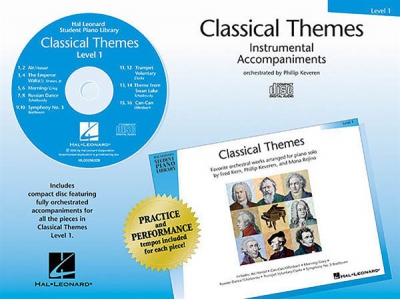
This compact disc correlates directly to the songs in Classical Themes Level 1. All track numbers for use with the compact disc are clearly indicated in the book, and are listed on the actual CD as we... Lire plus
This compact disc correlates directly to the songs in Classical Themes Level 1. All track numbers for use with the compact disc are clearly indicated in the book, and are listed on the actual CD as well. These fully-orchestrated accompaniments by Hal Leonard Student Piano Library method author Phillip Keveren are a delightful way to enhance students' lessons, and are a sure way to guarantee practice success. Whenever we have included CD accompaniments for any series within the Hal Leonard Student Piano Library, the CD format is as follows: each piece has two tracks. The first track is at a practice tempo with the solo piano part, and the second track is at a performance tempo without the piano solo part. / Piano
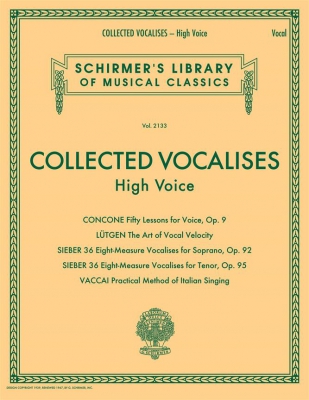
With over 150 vocalises, this collection will be very useful for many teachers and students of singing. Includes CONCONE: Fifty Lessons for Voice, Op. 9 - LÜTGEN: The Art of Vocal Velocity - SIEBER: ... Lire plus
With over 150 vocalises, this collection will be very useful for many teachers and students of singing. Includes CONCONE: Fifty Lessons for Voice, Op. 9 - LÜTGEN: The Art of Vocal Velocity - SIEBER: 36 Eight-Measure Vocalises for Soprano, Op. 92 - SIEBER: 36 Eight-Measure Vocalises for Tenor, Op. 95 - VACCAI: Practical Method of Italian Singing / Voix
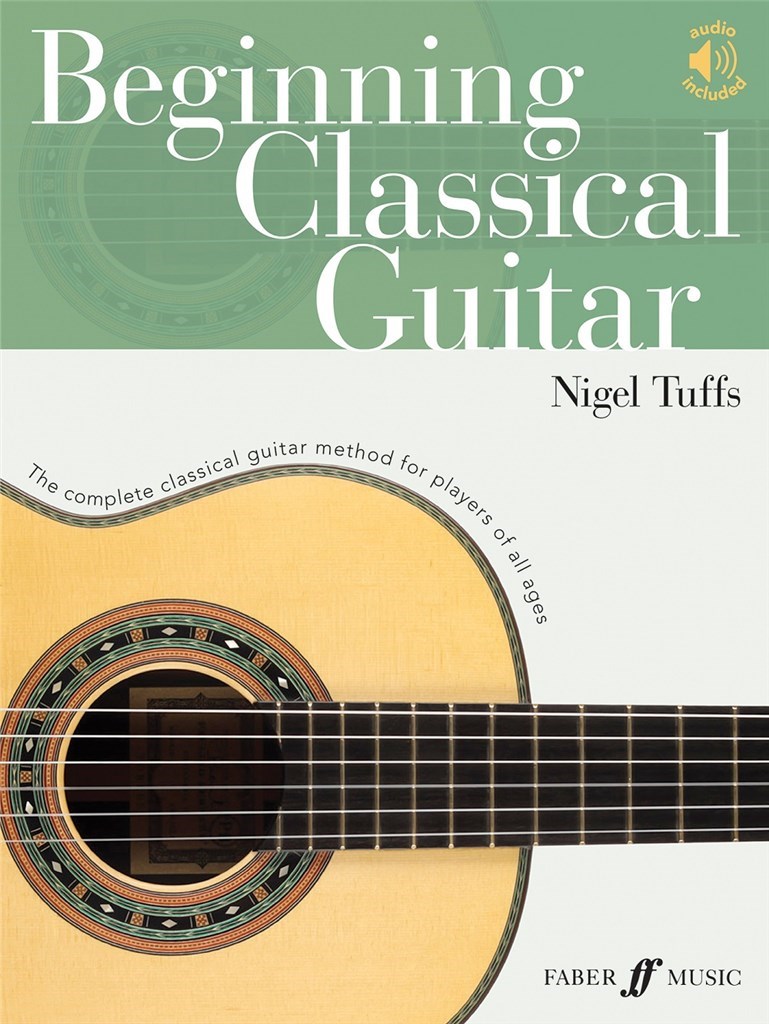
Par TUFTS NIGEL. Beginning Classical Guitar is the ultimate method for students of all ages, ideal for use in individual or group lessons, as well as for self-taught players. It provides a concise, ea... Lire plus
Par TUFTS NIGEL. Beginning Classical Guitar is the ultimate method for students of all ages, ideal for use in individual or group lessons, as well as for self-taught players. It provides a concise, easy-to-follow introduction to both the classical guitar techniques and music notation required to reach Grade 1 (early elementary level), supporting all major exam syllabuses. With helpful diagrams, exciting backing tracks to bring practice to life and demonstration audio recorded by Nigel himself, this book is sure to motivate all aspiring classical guitarists to start playing. / Date parution : 2021-11-03/ Méthode / Guitare Classique
The Easy Concert Pieces series provides a veritable treasure trove of easy repertoire for lessons, concerts and enjoyment, carefully selected by Rudolph Mauz, in accordance with pedagogical methods. F... Lire plus
The Easy Concert Pieces series provides a veritable treasure trove of easy repertoire for lessons, concerts and enjoyment, carefully selected by Rudolph Mauz, in accordance with pedagogical methods. Featuring works from the Baroque to Modern eras, a wide variety of styles are covered. Volume 1 contains easy pieces that are playable in the first two years of lessons. The included piano accompaniments are also easy and therefore can be played by another student. Alternatively all accompaniments are available on the play-along CD. / Clarinette Et Piano
Any violinist who hears the name Sitt nowadays will probably just think of the author of studies and exercises that have long been a familiar feature in instrumental lessons. Of course the Prague viol... Lire plus
Any violinist who hears the name Sitt nowadays will probably just think of the author of studies and exercises that have long been a familiar feature in instrumental lessons. Of course the Prague violinist, music teacher and composer Hans Sitt (1850-1922) made a significant impact on methods of violin teaching, but he also wrote a whole series of other works worth listening to: concertos for violin, viola and cello and chamber music for various combinations of instruments. Sitt studied the violin in Prague and was then appointed first as leader of the orchestra and then as musical director in Breslau (now called Wroc?aw).After posts as director of music in Prague, Chemnitz - where he championed the work of Smetana - and Nice, he was eventually appointed professor of violin, orchestral playing and score reading at the Leipzig Conservatoire from 1884-1921. Besides this he also played viola in the Brodsky Quartet, organised concerts and was conductor of the Bach Society. The composers Franco Alfano - who completed Puccini's unfinished opera Turandot- and Frederick Delius studied with Sitt, as did the conductor Václav Talich. Three Album Leaves op. 13 were also composed during his time in Leipzig, published by Bosworth and Co in 1894. Romanesca, #1 in that collection, is a pretty, slightly melancholy piece of music with romantic appeal that draws out lyrical and expressive playing and is thus eminently suitable for tuition purposes and concert performances. / Violon Et Piano
Par GUNOD NATHANIEL. For music lovers who\'ve always wanted to play guitar but have been put off by traditional guitar methods, these books get you playing right away without having to pick through he... Lire plus
Par GUNOD NATHANIEL. For music lovers who\'ve always wanted to play guitar but have been put off by traditional guitar methods, these books get you playing right away without having to pick through heavy theory and music-reading lessons first. Every book in the For Beginners series progresses from the very basics of buying your first instrument through the fundamentals of playing your favorite style of music. 48 pages each with enhanced CD. / Niveau : Débutant / Méthode en anglais / Méthode / Guitare
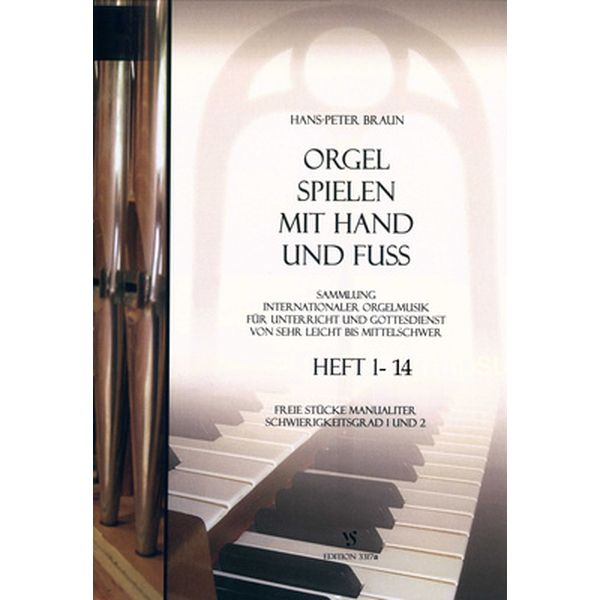
Méthode d'orgue - Collection de musique d'orgue internationale pour l'enseignement et les messes - Comprend les 13 volumes de partitions et le volume de registre - Publiée par ... Lire plus
Méthode d'orgue - Collection de musique d'orgue internationale pour l'enseignement et les messes - Comprend les 13 volumes de partitions et le volume de registre - Publiée par Hans-Peter Braun - Niveau de difficulté facile à moyennement élevé - N° d'édition VS 3317X - Format: 25 x 29,7 cm